EU-China News Brief - 30 March 2020
LISTEN TO OR READ THIS WEEK’S TOP EU-CHINA STORIES
This week’s TOP News:
Brussels Shifts Its Stance on China's Support - "Global Battle of Narratives" Amid COVID-19
Scandals of China's Mask-Diplomacy
China's Mask Diplomacy - Donations vs. Sales in Perspective
Has G20 Succeeded Where G7 Failed?
EU Commission Emphasises FDI Screening Amid Potential COVID-19 Buyouts
1. Brussels Shifts Its Stance on China's Support - "Global Battle of Narratives" Amid COVID19
► Brussels shifted its stance on China's support, as HR Josep Borrel warned the EU to be mindful of the "global battle of narratives" and "politics of generosity" surrounding COVID19;
► Ambassador Zhang Ming from Mission of China to the EU dismissed geopolitical interpretations;
► Almost 40 MEPs express concern over Chinese and Russian disinformation in a letter to the Commission and the Council;
► The EU (with support of President Macron) intensified efforts to communicate its active response to the crisis, but fostering EU solidarity remains a challenge as member states disagree on "coronabonds".
Generosity Geopolitics:
On March 23rd EEAS official website released a blog post by High Representative Josep Borrell, in which he:
Called the communication and misinformation efforts related to COVID-19 a "global battle of narratives"
Warned the EU: "We must be aware there is a geo-political component including a struggle for influence through spinning and the ‘politics of generosity’. Armed with facts, we need to defend Europe against its detractors."
That was a reference to China's "support" in which lines between donations and commercial offerings are being blurred and extensive reporting on which has been undermining EU's position
China's Response:
Ambassador Zhang Ming of Mission of China to the EU responded (without direct reference to HR's blog post) via a signed article sent to Brussels Times, Euractiv, and EUobserver on 26th of March.
Most of the response Ambassador Zhang applied a conciliatory, cooperation-focused language, but he also strongly rebuffed geopolitical interpretations of China's actions
"Our fight against the virus has nothing to do with social system or geopolitics. To politicize the outbreak or view China’s efforts with suspicion is nothing but parochial and detrimental."
EU's PR Push:
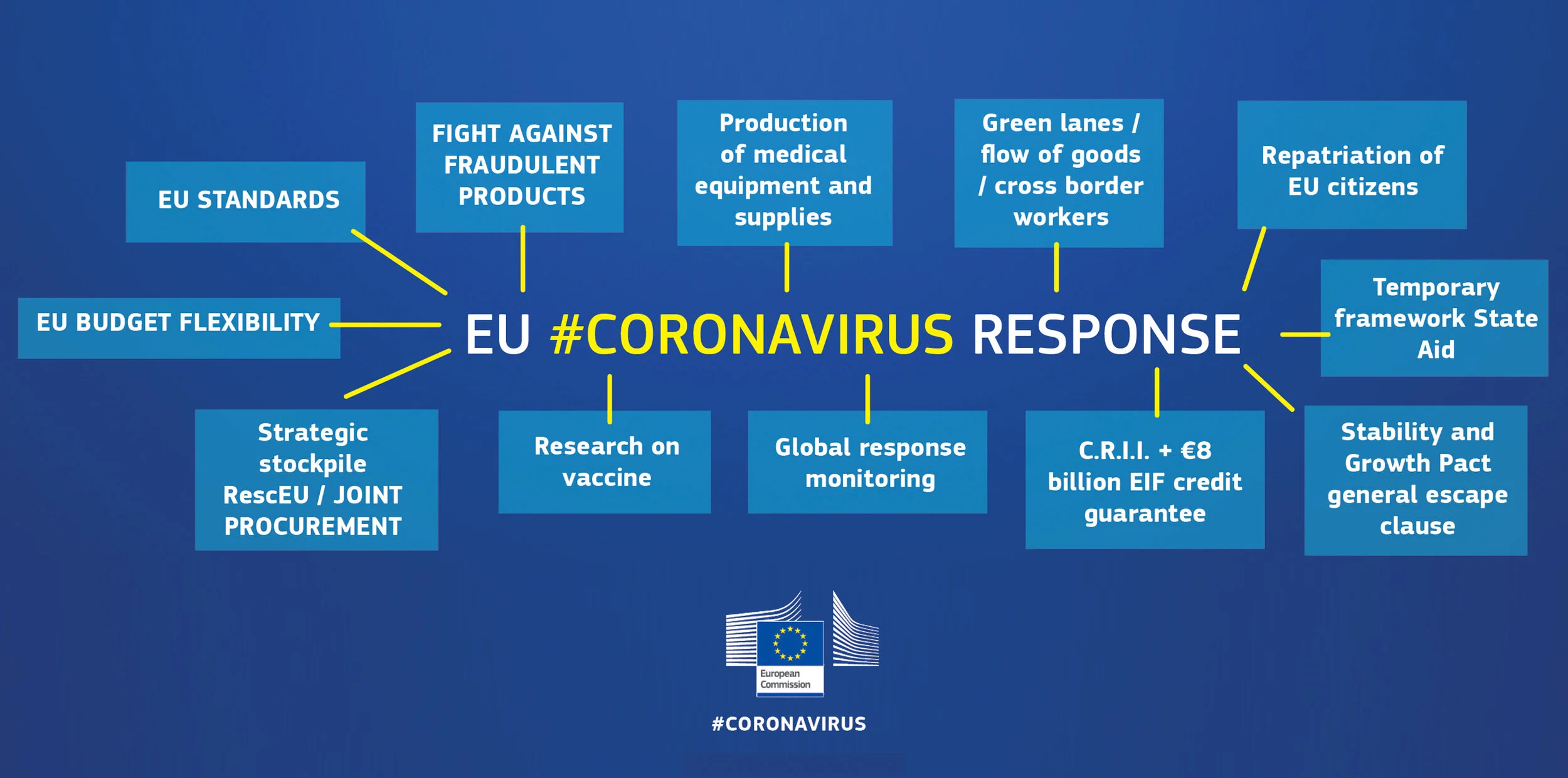
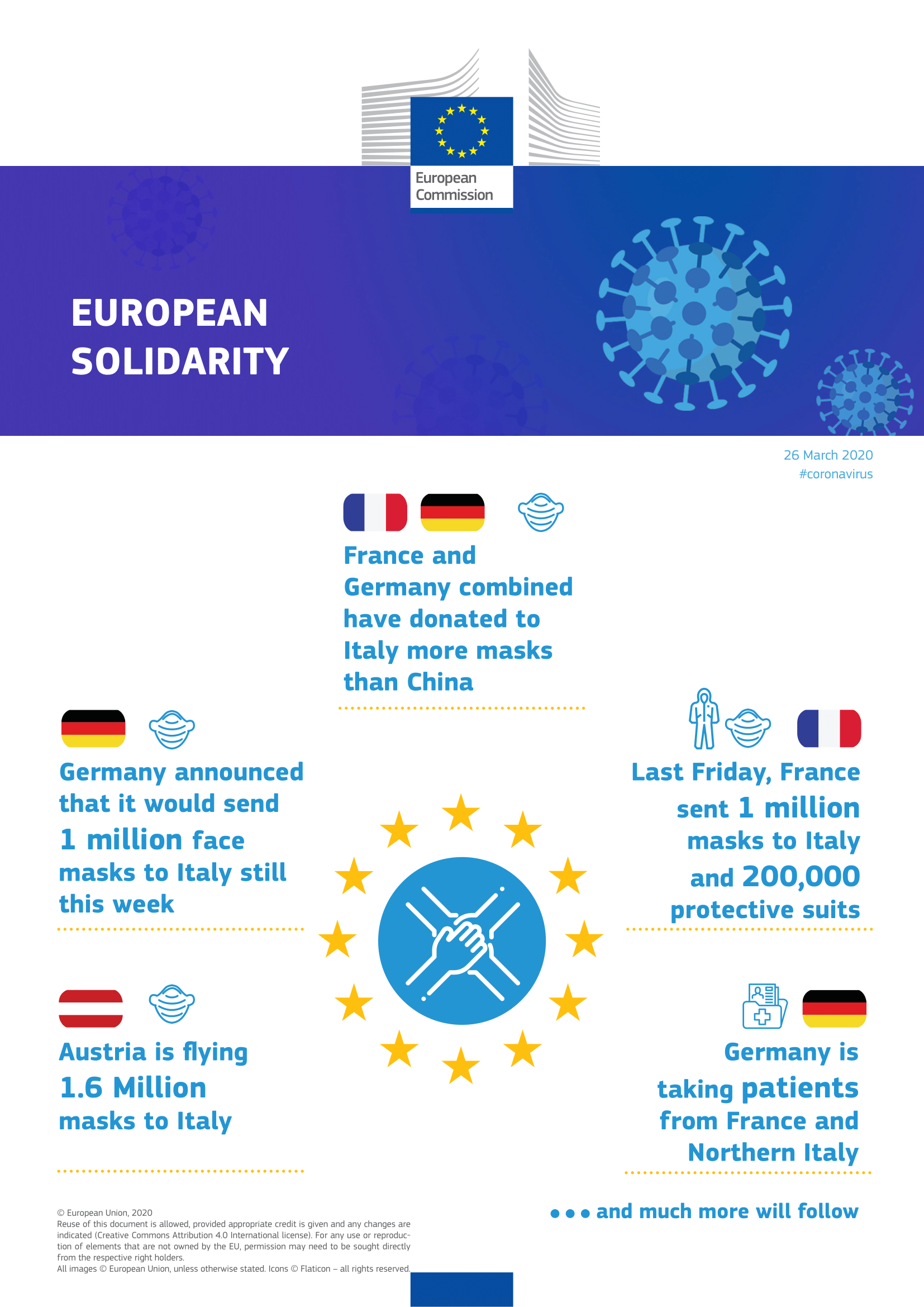
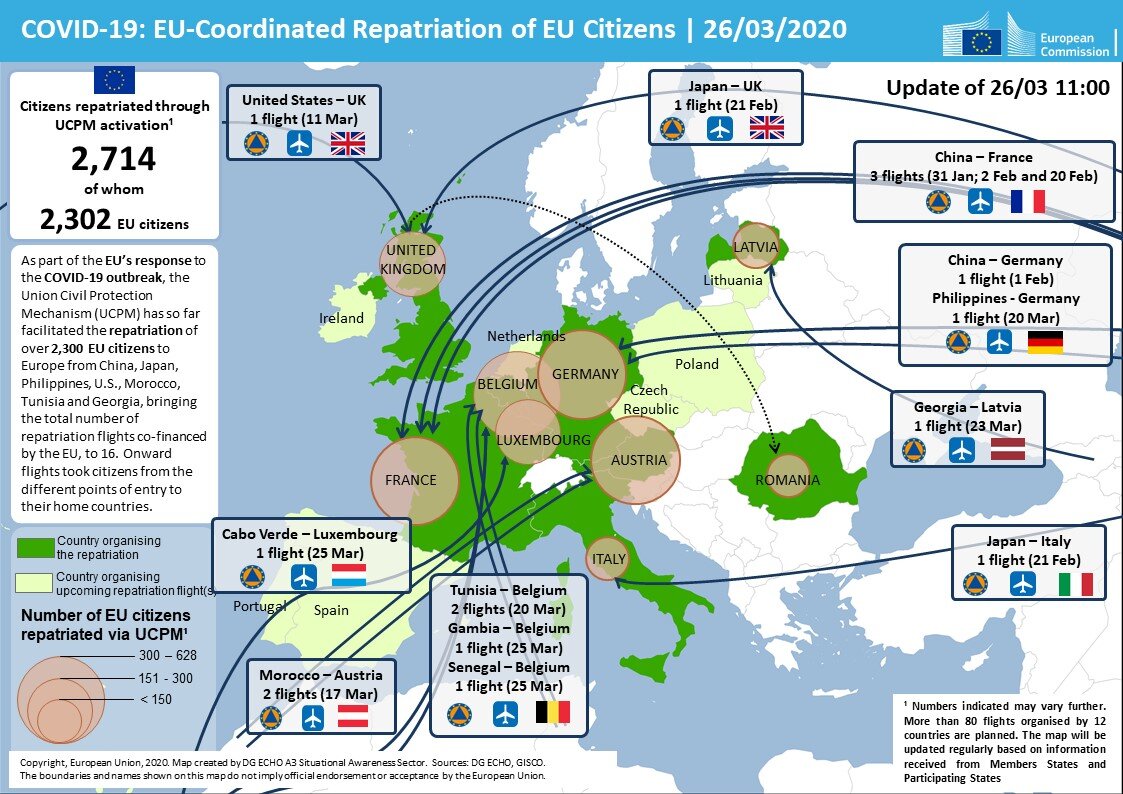
Following Borrell's statement, EU institutions and its officials intensified the messaging about the EU solidarity and the EU's response to coronavirus.
The following infographics were sent from the EU Commission's Twitter account on March 25th and 26th.
President Macron emerged as the most vocal European leader calling for acknowledgement of the EU's efforts.
In an interview with leading Italian newspapers on March 28th, Macron stated that:
“There is a lot of talk about Chinese or Russian aid, but why don’t we say that France and Germany have delivered 2 million masks and tens of thousands gowns to Italy?”
MEPs Concerned About Disinformation:
On 27th of March, a group of almost 40 MEPs sent a letter to President von der Leyen, President Michel, and HR Borrell acknowledging the challenge of the misinformation efforts primarily by China and Russia. The letter was obtained by Politico's Brussels Playbook:
"We are seriously concerned about current disinformation and propaganda efforts coming especially from China and Russia. It is clear to most of us observing the situation that there is an effort to undermine the EU and sow mistrust among the local population and European neighbours towards the EU, its democratic values and institutions."
Corona Bonds Divisions:
But the solidarity still doesn't go as far to agree on issuing pan-EU corona bonds - strong North-South divisions emerged during EU summit on March 26th.
Corona bonds - a new financial instrument, a community bond that would combine securities of Eurozone countries helping to issue a new kind of debt for most vulnerable member states.
Similar idea (euro bonds) was discussed as a measure to address the Eurozone crisis following the global financial crisis of 2008, but it was met with strong opposition from Germany.
Italy, France and other southern European countries are for, but Germany, Netherlands, Austria and Finnland are strongly against.
German government instead suggests broadening access to European Central Bank's toolbox - including the European Stability Mechanism (ESM) backstop fund with a €410 billion preventive credit line. The Dutch government opposes using these funds at such an early stage of the COVID crisis.
Christian Kastrop, the director of the "Future of Europe" at the Bertelsmann Foundation summed it up this way:
"Either the member states issue community bonds, sharing volume and risk. Or the ECB will become a real buyer of last resort."Sending a message of unity remains crucial, as stated by Italian Prime Minister Giuseppe Conte on March 28th:
"If Europe does not rise to this unprecedented challenge, the whole European structure loses its raison d'etre to the people"
TAKEAWAYS
► SHIFT ON CHINA
A clear shift of stance on China's "support" took place in Brussels. Borrell's message and the letter from MEPs stand in stark contrast to the message of gratitude towards China sent by President von der Leyen last week, which we discussed in the last news brief. We will see more of this new approach in the fifth news bite.
► INTERNAL PR
Regardless of the EU leader's ability to devise a response to COVID-19 crisis, the EU has to find new ways to communicate with the wider European public - also those parts, who don't follow the institutions' social media accounts. As the economy will inevitably take a hit, many national governments are likely to use Brussels as a scapegoat. The EU needs to do more than defensively respond to disinformation and needs to communicate outside of the pro-European echo chamber. This is a long-standing issue, but now it is crucial to take it on.
READ MORE:
The Coronavirus pandemic and the new world it is creating - EEAS (HR Josep Borrell), Mar 23
Ambassador Zhang Ming:To Fight the Pandemic, Put Trust and Cooperation Before Politics - Chinese Mission to the EU (Amb. Zhang Ming), Mar 26
Macron says France is there for Italy, Europe must not be 'selfish' - Reuters, Mar 28
Calls for Corona Bonds Met with Familiar "Nein" - France24, Mar 27
Italy says virus response fateful for EU - France24, Mar 28
POLITICO Brussels Playbook: Outrage in Rome, damage limitation in Brussels — VDL responds — Rules are rules - Politico (Florian Eder), Mar 30
2. Scandals of China's Mask-Diplomacy
► Chinese medical supplies sent to the Czech Republic, Spain, and the Netherlands are at the heart of scandals over speculation and life-threatening quality;
► While this is only a small part of China's med equipment exports to the EU (as donations and sales), China's image among European public is bound to take a hit.
Czech Republic - Med Equipment Speculation & Faulty Test Kits:
March 16: Czech police raided a warehouse belonging to Zhou Lingjian - a prominent figure in Chinese diaspora in Czechia - who has links to the United Front. The investigation followed a Czech company gauging prices of medical equipment. Police found 28k respirators and 680k face masks - around 100k face masks were labelled as Chinese Red Cross' aid to Italy - possibly stolen. This did not make the headlines.
March 22: Italian region of Lazio accused Czech authorities of seizing the masks - aid, which the region was supposed to receive from China. It was widely reported as a case of divisions and lack of solidarity among EU members.
March 23: Czech authorities confirmed that the masks are part of the investigation, but sent a transport of 100k masks to Italy. However, the message did not circulate in the media with equal strength.
On a separate note - on March 23rd Czech media reported that 80% of the 300,000 rapid coronavirus test kits batch ordered from Chinese company Innovita Biological Technology are unusable. The test kits are worth €1.83 million.
On March 28th the company issued a statement responding to the allegations saying that the tests must have been used without adherence to the company's instructions (link in Chinese).
Spain - Inaccurate Test Kits:
Spanish government purchased 58,000 COVID-19 testing kits from a company called Shenzhen Bioeasy Biotechnology
Tests were supposed to have an 80% accuracy rate, but reports emerged that the first batch is unusable being only 30% accurate
On March 26th the Spanish government announced that the kits will bee returned to the manufacturer, who is going to exchange them
Spanish government confirmed that it was not part of the €432 million contract with China announced on March 25th, which involves the delivery of 5.5 million testing kits. It also mentioned that the Bioeasy's testing kits were bought through a Spanish company.
The Chinese Embassy in Spain announced on Twitter:
“The Chinese ministry of commerce offered Spain a list of certified providers, which did not include Shenzhen Bioeasy Biotechnology. Shenzhen Bioeasy Biotechnology has not yet been licensed by the Chinese National Medical Products Administration to sell its products.”
Netherlands - Unsafe Masks:
On March 28th reports emerged that the Dutch authorities asked hospitals to return around 600,000 face masks (out of 1.3 billion so-called FFP2 masks from China), some of which have already been in use;
The masks coming from a Chinese manufacturer arrived in the Netherlands on March 21st. Many had defects - not being able to cover the doctors' faces or had defects in their filter membranes making them ineffective against COVID-19 virus
Dutch Health Ministry announced it would conduct extra tests on any future transports from China.
China's response:
In today's (Mar 30) Chinese MFA Press Conference, spokesperson Hua Chunying responded to the controversies stating:
"If problems occur in this process, the Chinese side will talk to relevant departments. Problems should be properly solved based on facts, not political interpretations. In fact, when we first began fighting COVID-19 at home, some of the assistance China received was defective, but we chose to believe and respect the kind intentions of these countries."No further information was provided in regard to which countries sent China defective
TAKEAWAYS:
► HUGE PR HIT
Those may be isolated cases in a huge mosaic of med equipment supplies coming from China to Europe, but the damage to China's image and trust towards its equipment is huge. While there is no real alternative to Chinese suppliers at this stage, the European governments just got an additional motivation to beef up production of medical equipment within the EU. Also, the response of Chinese MFA's spokesperson has been poorly received in the Twitter-sphere in Europe - people might have been more understanding if China has not been so actively promoting its "mask diplomacy" over the last couple of weeks.
► TO BE EXPECTED?
Let's keep in mind that over the last weeks, multiple Chinese companies rapidly adjusted their businesses to be able to produce the necessary equipment. The pace at which this was happening was bound to produce room for speculators and limit the abilities to perform quality checks. While this is not an excuse, it surely provides the context to "insufficient quality" scandals. Another option - following the reasoning presented by Chinese manufacturers - is that some of the equipment has not been used properly (which sounds a bit hard to believe).
READ MORE:
Confiscated face masks imported by an influential Chinese representative in Czechia - Aktuálně.cz (Lukáš Valášek), Mar 26
Confiscated face masks imported by an influential Chinese representative in Czechia - Aktuálně.cz (Lukáš Valášek), Mar 26
Spain returns faulty test kits to China as COVID-19 death toll passes 4,000-mark - Euractiv, Mar 27
Spanish government under fire after defective testing kits fiasco - Politico (Cristina Gallardo), Mar 27
Coronavirus: Netherlands recalls 'defective' masks bought from China - DW (Ankita Mukhopadhyay), Mar 29
The Netherlands has recalled 600,000 coronavirus face masks it imported from China after discovering they were faulty - Business Insider (Adam Payne, Sinéad Baker and Ruqayyah Moynihan), Mar 29
Foreign Ministry Spokesperson Hua Chunying's Regular Press Conference on March 30, 2020 - FMPRC, Mar 30
3. China's Mask Diplomacy - Donations vs. Sales in Perspective
► Chinese companies have indeed been providing donations of medical equipment to EU countries - e.g. Alibaba pledging 2 million masks;
► But key amounts arrive in the EU as part of commercial agreements discussing amount of ordered masks in billions;
► It's important to be grateful for the help, but understand its scale.
Donations - Major Examples:
Alibaba pledged to donate 2 million masks to Europe governments and additional 500,000 and 30,000 test kits to Belgian authorities (Alibaba has its European distribution hub in Liège). On March 20th Spanish King Felipe VI thanked Jack Ma for providing 500,000 masks to Spain.
Huawei donated 1 million face masks to Spain, 838,000 for the Netherlands, 200,000 for Italy, 12,000 for Poland and an undisclosed amount for Greece before announcing that it will stop its donations following HR Borrell's post.
Oppo (Smartphones producer) donated 300,000 masks to Spain, Italy, Germany, France and Japan.
Others:
• On March 23 the Sany Group, machinery manufacturer sent 50,000 medical masks from Changsha to Bedburg in Germany, where the group has its European headquarters.
• Various Chinese charities donated to Italy 500,000 masks, 4 tons of medical material, 1,800 protective suits and 150,000 protective gloves
• Various Beijing-based NGOs sent 1 million masks to France
Sales - Major Examples:
While those numbers are impressive, the amounts ordered through commercial offerings put things in perspective:
France confirmed on March 28th that it ordered over 1 billion face masks, (majority from China)
The Netherlands contracted 1.3 billion FFP2 masks from Chinese suppliers (as described in news bite 2)
Many European countries also established air-bridges with China to ensure stable supply of medical equipment
• Poland - air-bridge was constructed following a call between President Xi and President Duda on March 24th. The first transport involved 1.7 million masks, 40,640 protective suits, 10,000 goggles, and 416,500 gloves purchased for €1.15 million
• Czech Republic - was among the first countries to establish an air-bridge with China. The first transport of 1.1 million FFP-2 level respirators arrived on March 20th and was the first from a series of transports that are to arrive over six weeks.
Putting China's Support in Perspective:
So let's put the donations in perspective
French Health Minister Olivier Veran said that France currently uses 40 million face masks per week, with the country being "stocked up" for around 3 weeks.
That allows putting the widely reported donations in perspective - for example, 2 million mask donation from Alibaba
If that donation was sent to France only, it would "buy" the country around 8.5 hours
TAKEAWAYS:
► BE GRATEFUL...
It is not to undermine the value of the donations, which came at the time of need when Europe has been "getting its act together" to respond to the COVID-19 crisis. It is important to appreciate that China reciprocated the EU's support shown when China was at the hight of its battle with COVID-19 battle.
► ...BUT BE MINDFUL
But it is also important not to give in to the impression that China is providing game-changing amounts of donations and has been saving the passive EU, which is a narrative that has been visible in the media over the last couple of weeks. Meaningful amounts of equipment are coming through commercial deals, which is fully understandable and the EU still relies on China's exports of medical equipment. China is eager to provide it, especially given the overall falling demand globally, which undermines the ability of China's economy to recover quickly (we talked about it in the last news brief).
READ MORE:
Capitals Special Edition – How effective is China’s ‘mask diplomacy’ in Europe? - Euractiv (Multiple contributors), Mar 26
France has ordered over 1 billion face masks, most from China: minister - Reuters, Mar 28
Huawei joins China’s Big Tech donation spree in Europe - Politico (Laurens Cerulus), Mar 25
Poland creates air bridge with China for coronavirus medical supplies - RMF24 (Justyna Lasota-Krawczyk), Mar 26
Czechs get first batch of sorely needed gear from China to fight coronavirus - Reuters, Mar 20
4. Has G20 Succeeded Where G20 Failed?
► G7 video conference of ministers of foreign affairs concluded without a joint declaration, as the American authorities demanded to name COVID-19 as the "Chinese virus" or the "Wuhan virus" - something other participants viewed as counterproductive;
► G20 summit concluded with better results as the leaders agreed to inject $5 trillion into the global economy and the IMF declared readiness to provide an additional $1 trillion in support;
► Still, no concrete global, multilateral vision has been agreed upon.
G7 (March 25th):
The grouping involves Canada, France, Germany, Italy, Japan, the UK, and the US.
The virtual meeting of ministers of foreign affairs concluded without results and without a joint declaration.
The reason behind this was disagreement on how to describe the coronavirus, which Secretary of State Mike Pompeo insisted on naming the "Chinese virus" or the "Wuhan virus".
Other participants viewed as counterproductive taunting of China at the time a global response to coronavirus is needed.
G20 (March 26th):
The summits (including the EU and China) have been arranged since the global financial crisis of 2008 and brings together both developed and developing economies.
Leaders agreed to inject more than $5 trillion into the global economy, which is roughly the same as the amount injected in response to the global financial crisis.
The G20 participants are going to cooperate to ensure the flow of medical equipment (but not calling for ending bans on equipment exports), goods and address supply chain disruptions.
IMF Managing Director Kristalina Georgieva participated in the summit and the following day (March 27th) the IMF announced that it is ready to offer $1 trillion support to its member states and that it will:
"Provide relief for debt repayments for its poorest members under the Catastrophe Containment and Relief Trust and is being called upon to strengthen its crisis response by enhancing access to its emergency facilities under the Rapid Credit Facility and Rapid Financing Instrument."According to Mark Sobel, a former US Treasury and IMF official now affiliated with CSIS:
“It’s endorsing what’s already being done in various countries but it isn’t offering a multilateral, global vision.”
READ MORE:
G7 countries fail to deliver a joint statement because US insists on saying 'Wuhan virus' for the coronavirus - Business Insider (David Choi), Mar 25
G20 leaders to inject $5 trillion into global economy in fight against coronavirus - Euractiv, Reuters, Mar 27
Joint Statement by the Chair of International Monetary and Financial Committee and the Managing Director of the International Monetary Fund - IMF, Mar 27
5. EU Commission Emphasises FDI Screening Amid Potential COVID19 Buyouts
► The EU Commission recommended member states to make used of FDI screening mechanism to mitigate the risk of foreign takeovers of strategically sensitive companies amid COVID19-induced economic crisis;
► China is most likely the primary concern, as the mechanism was put in place as a response to an increase of Chinese M&A in Europe.
Announcement: On March 25th President von der Leyen warned the member states that the economic havoc brought about by COVID19 outbreak can leave strategically important companies (e.g. in the high-tech industry) vulnerable to foreign takeovers.
FDI Investment Screening: The EU Commission released a communication urging each member state to:
Make full use already now of its FDI screening mechanisms to take fully into account the risks to critical health infrastructures, supply of critical inputs, and other critical sectors as envisaged in the EU legal framework;
For those Member States that currently do not have a screening mechanism, or whose screening mechanisms do not cover all relevant transactions, to set up a fullfledged screening mechanism and in the meantime to use all other available options.
TAKEAWAYS:
► GROWING CONCERNS
President von der Leyen's announcement shows the EU's growing concerns about how China's influence in the EU may grow in the aftermath of COVID19 outbreak. Remember that the FDI Screening Mechanism came into force in March 2019 primarily as a response to growing Chinese investments within the EU. Last year MERICS reported that as much as 83% of 2018 Chinese over €1 mln M&A in Europe would have met the criteria to be investigated if the mechanism had been already in place.
► TRUST-DEFICIT
Add together the PR "politics of generosity", reserves towards the reliability of Chinese medical equipment, and anxiety over potential buyouts and it seems that the EU-China cooperation on combating COVID19 outbreak and its after-match will be conducted in a context of increasing trust -deficit.
READ MORE:
Guidance to the Member States concerning foreign direct investment and free movement of capital from third countries, and the protection of Europe’s strategic assets, ahead of the application of Regulation (EU) 2019/452 (FDI Screening Regulation) - European Commission, Mar 25