EU-China News Brief - 6 April 2020
YOUR WEEKLY SHOT OF EU-CHINA NEWS
1. China's Economic Recovery - Fact or Myth?
Economic Hit:
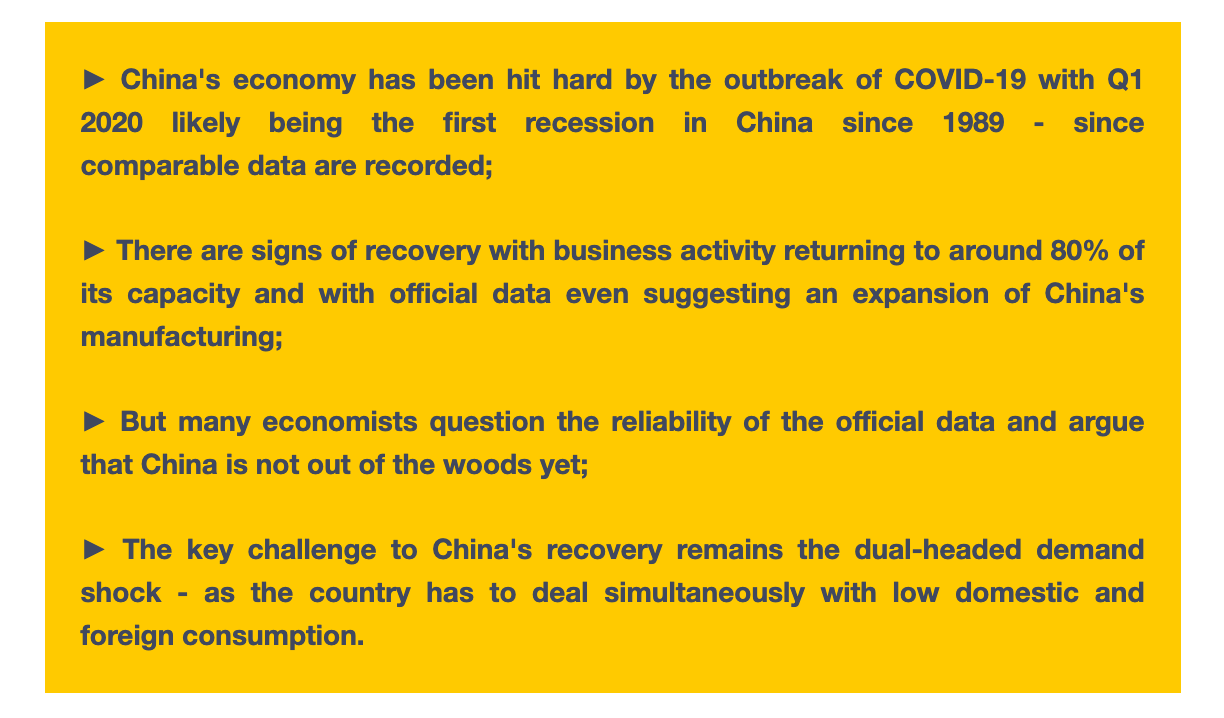
The outbreak of COVID-19 and announced mitigating measures hit China's economy hard. According to official data of the National Bureau of Statistics of China, in the period Jan-Feb 2020 in comparison to the same period in 2019:
⬇️ 24.5% - Investment in fixed assets (excl. rural households
⬇️ 20.5% - Retail Sales (first decline since it is being recorded)
⬇️ 15.9% - Value of Exports
⬇️ 13.5% - Industrial Production
⬇️ 13.0% - Services Production
⬆️ 1% - Unemployment (Dec to Feb) reaching the highest recorded level of 6.2%
➡️ This sums up to a negative GDP forecast for Q1 2020, which would be the first recession since 1989 when China started to release stats comparable to those available today.
Recovery Facts:
Over the last two weeks we could observe an increased reporting of positive signals about China's economic comeback after COVID-19 lockdown:
Government data suggests that 95% of large manufacturers returned to work.
Authorities even report that China's manufacturing expanded in March with PMI (purchasing managers' index - explained) reading of 52.0 vs. economists' expectation of 44.8 and record low recorded in February 35.7 (level above 50 means that the economy is expanding).
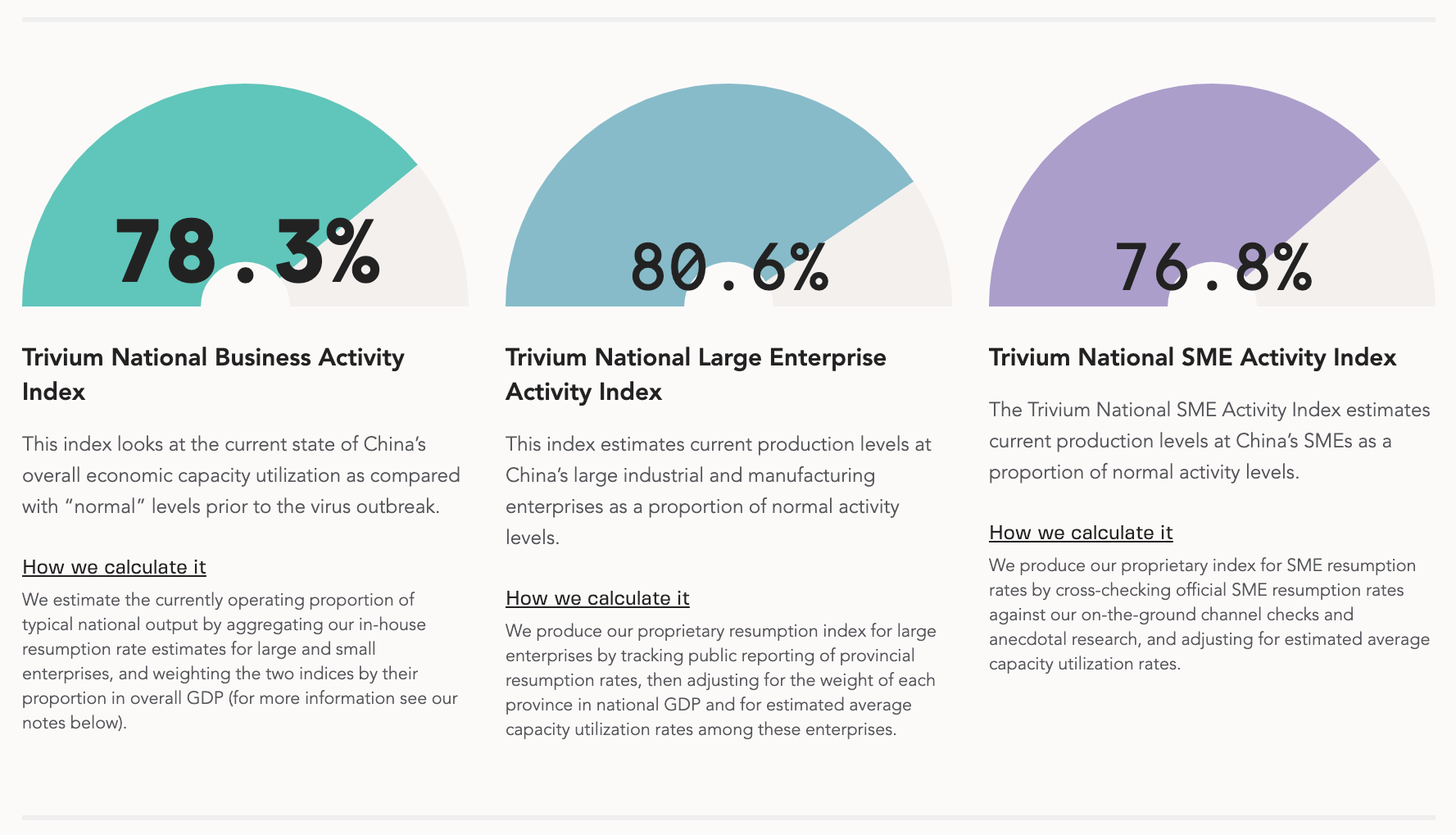
According to Beijing-based strategic advisory company Trivium China, the business activity indexes in China stabilised at close to 80% of pre-crisis levels.
Demanding Challenge:
It appears that the supply shock is over and China now has to deal with the dual demand shock - limited consumption on both domestic market and foreign markets:
Chinese exporters have to face limited demand as European and American consumers are under lockdown.
Domestically, 65% of Chinese consumers plan to limit their spending habits.
That's a big deal - domestic spending in 2019 made up around 58% of China's GDP growth.
Local governments of more than 30 provinces and cities plan to stimulate consumption by issuing digital coupons distributed via payment apps such as Alipay and WeChat Pay - in Hangzhou alone (where Alibaba has its HQ) we're talking about CNY 1.68 billion (€219 million) in small discounts.
Chinese government also decreased the bank lone rates by the biggest level since 2015, which may stimulate the economy, but increase debt levels.
Myth Busters:
But there are many signals that question China's economy's ability to quickly bounce back:
Independent China economy tracker China Beige Book questions official data and estimates that China's economic performance in March was even worse than in January
CICC (China International Capital Corporation), one of China's leading brokerages, slashed its forecast of 2020 GDP growth to 2.7 per cent, far below the official goal of 6%.
Mr Ma Jun, an academic member of the People’s Bank of China’s monetary policy committee, made comments in state-owned Economic Daily saying that the initial goal may be unreachable.
That shows that Beijing may be rethinking its plans to reach Xi's Centenary goal of reaching a Moderately Prosperous Society in 2021.
Also, remember that although China has been through the first wave of COVID-19, the disease is likely to come back in subsequent waves, which Beijing seems to be eager to blame on foreigners living in the country.
An additional psychological hit comes from the fact that gaokao, the nation-wide post-high school exam, was postponed to July 7-8th by the Ministry of Education - the first time since the Cultural Revolution.

TAKEAWAYS
► SO? FACT OR MYTH?
It appears that China's economy is in for a bumpy ride and the decision regarding how to deal with the situation is forming right now. It is quite likely that we are going to see an initial overreporting of success paired with a wide range of actions to stimulate the economy - likely led by the party-state. Consequently, China may delay the problems short-term, but that will come at a price mid-term - keep in mind the considerable debt the local governments are already in.
► WHAT DO WE DO?
In the words of President of the European Union Chamber of Commerce - Jörg Wuttke - we should try "not to waste a crisis". This is the time for the EU institutions and member states to actively engage Chinese partners suggesting a more liberal stance. This is what Beijing chose in response to most of the economic turmoil it has encountered over the last decades - until recently. So as much as it is more likely that Xi's China will want to see more party-state-led responses, the EU should support the more liberal voices in this discussion. The effects of those decisions will be felt for years to come.

READ MORE
China is using digital coupons to entice people to get shopping again - Quartz (Jane Li), Apr 1
Getting China back to work - Trivium China, Apr 2
COVID-19 crash: How China’s economy may offer a glimpse of the future - World Economic Forum (Jenna Ross), Mar 31
China's economic recovery from coronavirus could be ugly — and that's bad news for the rest of the world - ABC (Bill Birtles), Mar 28
Let’s not waste a crisis: message to members from European chamber president Joerg Wuttke - The European Union Chamber of Commerce in China (Joerg Wuttke), Mar 23
2. The Path Forward for Businesses in the EU and China
EU Firms in China Require Higher Demand:
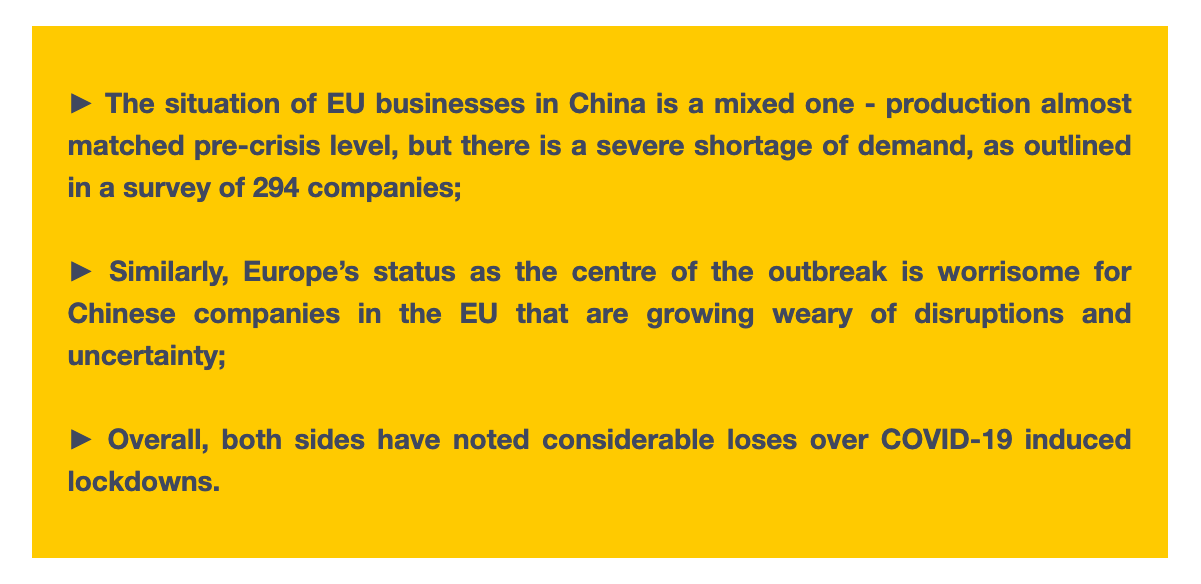
A report released on April 2nd by the Delegations of Germans Industry & Commerce (AHK) presents findings that allow us to extrapolate wider trends for other EU firms
The decline in infections and deaths in China allowed businesses to roll out production, but this falls short of sufficient
While EU companies are nearing pre-crisis production levels (by Q2, 85% staffing rate and 87% production & manufacturing capabilities will return to normal), low levels of demand and sales show there is still a long way ahead until normalcy, which the AHK predicts would happen by Q3 2020.
What EU firms need is financial support and fiscal stimulus. To kick start consumption in China, a set of local governments have put out consumption coupons to increase demand. That could convince foreign companies to rethink cancelling their investments, as several are considering)
But the bigger fear is that extended lockdowns in Europe and North America will hamper demand
Chinese Firms in Europe Fearful of Economic Downturn:
A survey by the China Chamber of Commerce to the EU (CCCEU) showed more 60% of Chinese firms in the EU fear there will be severe economic consequences after the health crisis is quelled
These firms already indicated the virus affected their business and expected the situation to remain uncertain into Q2. Only 18% indicated an optimistic outlook
The survey added the coronavirus impact to some pre-crisis grievances related to screening measures on FDI’s and other logistical operations (obtaining permits, securing credit financing, paying taxes)
Nonetheless, more than 50% of Chinese firms indicated in the survey they are planning to invest 5-20% more in their EU-based firms

TAKEAWAYS
► EU IN CHINA
EU businesses in China may see their short-term issues with demand be solved by consumption stimulus packages, but the long-term solution is dependent on Europe and North America flattening the curve and re-launching their economies to spur demand from China. This, in turn, will fuel the Chinese economy to allocate more stimulus and generate demand domestically (which would benefit EU firms).
► CHINA IN EU
The status quo in Europe is not clear yet, although this lack of clarity has created much uneasiness. Negotiations on corona bonds (or an equivalent) will have a bigger impact on what Chinese investors decide. Chinese investors are not pulling out yet, which is probably because they are waiting to see how the more fiscally-conservative members states (Netherlands, Germany, Austria, Finland) will budge to allow economic recovery for hard-hit countries (Italy, Spain).

READ MORE
COVID-19’s Future Impact on Foreign Companies in China: German Businesses on Track to Recovery – Demand now Major Concern - German Chamber of Commerce in China, Apr 2
Most Chinese businesses in Europe concerned about coronavirus impact on economy: survey - Xinhua (Mu Xuequan), Apr 1
CCCEU Survey explores growing complexities of European market amid pandemic - China Chamber of Commerce to the EU, Mar 31
Weekly global economic update, March 2020 - Deloitte (Ira Kalish), Mar 31In China, the time ‘after’ COVID-19 is beginning – but fear remains - Euractiv (Jörg Petring) , Mar 31
3. COVID-19 Disinformation Targeting “EU Disintegration” Spreads to the Balkans
EEAS Report on Disinformation:
On April 1st, the EEAS released a special report assessing the rhetoric of disinformation around COVID-19.
Global disinformation streams portrayed the EU as weak and lacking solidarity.
The news are vastly propagated on RT and Sputnik, which cover extensively Kremlin’s aid to Italy.
The misinformation also issues false health advice, claiming the virus was made in a laboratory or that washing hands does not help maintain health safety.
The fake news does not simply target the EU, it also provides exaggerated praise to Russia and China for their fight against the pandemic, and using the circumstances to claim that Chinese “global projects” are superior to the one of the EU.
Both Russia and China rejected the claims that they are behind the propaganda, but a report by Alkemy for Formice shows otherwise.
The report looks at Twitter posts that highlight Chinese intervention, indicating that up to 46% of the responses to these posts came from bots and fake accounts. Posts that clearly mention Italy and China in hashtags are the most susceptible.
The disinformation has serious implications. In Slovakia, 55.9% of Slovaks believe EU is not helping Slovakia enough, while 67% believe China is.
Polls conducted by news agency Dire on 12-13 March, 88% of Italians feel that Europe is failing to support Italy in the crisis, while only 4% believe that it is doing enough. And 67% of Italians regard EU membership as a disadvantage, up from 47% in November 2018.
The situation has prompted Ursula von der Leyen to announce on March 31st, that the Commission is working with online platforms (Google, Facebook, Twitter) to remove misinforming content.
Fake News Strikes the Balkans:
Emboldened by Serbian president’s Aleksandar Vucic’s harsh discourse on the EU, anti-EU narratives have sprung in Western Balkan countries as well.
The overarching narrative is that the health crisis is an example of the EU turning its back on the Balkans in a time of need.
Serbia has become very present in Chinese social media circles, as billboards thanking the PRC and Xi Jinping have emerged around Belgrade. The gratitude for Chinese intervention is strictly contrasted in social media discourse against the passive inactivity of the EU or, in more extreme cases, the EU is outright blamed for attempting to facilitate a foreign invasion.
Serbian President Aleksandar Vucic can be “thanked” for the spread of the misinformation too. His remarks from March 17th that COVID-19 exposes the EU’s “lack of solidarity” have proliferated in social media circles, helping portray China in a superior light.
EU Strikes Back:
To counter the fake news, the Commission pledged €40 million to Western Balkan countries.
Oliver Varhelyi, Commissioner for enlargement reached out to Western Balkan member states saying these are difficult times for both the EU and its partner countries
Most of the money will flow into Serbia (€15 million), while Albania, Montenegro, Bosnia, North Macedonia, and Kosovo will each receive between €3-7 million
The aid was complemented by another €374 million dedicated to helping Balkan economies recover after the health crisis
A further €140 million was dedicated to the countries in the Eastern Partnership (Ukraine, Georgia, Moldova, etc.)
The European Commission also launched a website called "Fighting Disinformation" dedicated to dismantling false narratives
These measures are the Commission’s manner of responding to Chinese propaganda efforts, particularly in Serbia, the hardest-hit country in the region

TAKEAWAYS
► MORE THAN ONE VIRUS
As the EU is gearing up to fight COVID-19, disinformation proves to be its digital equivalent. Ursula von der Leyen’s efforts to curb this dynamic are commendable, but they must also break beyond the circle of people who actively follow EU institutions/politicians on social media. As we argued in the last news brief, the EU needs to step up its game in terms of communication with the wider public.
► DIVIDE ET IMPERA
Disinformation bloomed more rapidly in countries that are harder hit - Italy or Serbia (which doesn’t display dramatic increases in infections but is more affected than any of its neighbours). This may point to a coordinated attempt to hit the weak spots of the chain and, by promoting alleged European disunity, create a fait accompli. Progress over the corona bonds negotiations will be a very strong display of European unity and it would help counter the disinformation from Russia and China. Similarly, the EU can improve in the marketing of its aid and outreach to the Western Balkans, where anti-EU sentiments are easier to ignite by external actors.

READ MORE
EEAS Special Report Update: Short Assessment of Narratives and Disinformation around the COVID-19 Pandemic - EEAS, Apr 1
Russia and China push ‘fake news’ Aimed at Weakening Europe: Report - Politico (Mark Scott), Apr 1
Statement by Ursula von der Leyen, President of the European Commission, on disinformation during the coronavirus crisis (English version) - European Commission, Mar 31
Coronavirus used to promote anti-EU narrative in Balkans, report finds - Euractiv (Vlagyszlav Makszimov), Apr 1
EU announces COVID-19 help for Balkans, Eastern neighbours after criticism - Euractiv, Mar 30
4. Taiwan Provides EU with Medical Aid
Taiwan’s Donation:
Taiwan’s Tsai Ing-wen, announced on April 1st a donation of 10 million masks to EU, US, and Taiwan’s diplomatic allies
Taiwanese authorities indicated 7 million masks were destined solely for the EU, UK, and Switzerland, at a time when donations from Mainland China were found to have deficiencies in Spain and Netherlands
This may well be Taiwan’s attempt to position itself as a leader in the fight with COVID-19 while attracting “like-minded countries”
Taiwan has been praised for its early action and efficient manner in holding infection rates at low levels (as of April 5th, Taiwan registered only 355 cases and 5 deaths, with 312 of cases imported, instead of being locally transmitted)
Taiwan’s success offers interesting health insights for the EU, prompting it to join efforts and discuss possible future collaboration
The Commission’s Response:
Ursula von der Leyen took to Twitter to thank Taiwan for the medical aid, branding the hashtag #StrongerTogether
It is a departure from standard EU policy, which usually preferred to have a low-key approach to relations to Taiwan. Von der Leyen’s post is a shift from that approach
Diplomatically, it is also a response to the “politics of generosity”, by mirroring Beijing’s call not to politicise mask donations
WHO in the crosshairs:
The donation was announced just days after an embarrassing call between RTHK, a Hong Kong broadcaster and WHO Assistant-Director General Bruce Aylward
When asked about Taiwan’s potential readmission into the WHO, Aylward pretended not to hear a question, then mimicked poor internet connection by hanging up the video call
This comes just one week after Taiwan accused WHO for lack of communication and cooperation, in spite of its well-managed outbreak and low infection ratio
The video call went viral, prompting backlash against excessive influence of Mainland China over WHO, while also drawing the Hong Kong commerce ministry to criticize RTHK for challenging the “one-China principle”
No Response from Beijing:
Despite the sensitive nature of the issue, Mainland China did not issue any comeback on the EU
However, a Mainland China MFA spokesperson did issue a statement indicating that Taiwan’s help is welcomed, but it should not be politicized
Furthermore, HR Josep Borrell and Chinese Foreign Minister Wang Yi spoke over the phone on April 3rd, categorizing international solidarity and cooperation as essential
No statement was made about the EU’s response to the donation

TAKEAWAYS
► Plus ça Change...
As we discussed last week, the European Parliament, the EEAS, and the Commission are shifting towards a more assertive rhetoric towards Beijing. Now von der Leyen seems to be making a statement within “the global battle of narratives” and responding very positively to Taiwan’s donation - potentially as a payback to Beijing’s mask diplomacy amid some equipment quality scandals. Using Beijing’s own calls not to treat aid as a political statement, Brussels shows its discontent and communicates that it will not remain passive when faced with political discourses attached to aid, while Taipei scores a PR goal.
► ...Plus C'est la Même Chose
But note Beijing’s limited reaction and the call between Borrell and Wang Yi. It may be that the diplomatic discussion happened between the closed doors and Beijing just decided to ignore the issue. Similarly like last week we played a numbers game on Beijing’s donations, we have to be fair and look at Taiwan’s aid through the same lense. 7 million masks would be sufficient to supply France, which we used in the example last week - for a day and a half, so the donation - while greatly appreciated and touching given the number in comparison to Taiwan’s size - will not change the fact that the EU countries will continue to order vast majority of their supplies from the Mainland. So the member states likely won’t do anything that would anger Beijing too much - and cross-strait sensitivities definitely fall into that category.
► Democratic Alternative
Taiwan’s impressive handling of the public health crisis raises questions about the necessity to impose harsh measures in order to contain the virus, which may prove very attractive to the EU and its member states as discussions on how to end the lockdowns are continuing. Taiwan’s move can draw attention to its case and may further promote studying the measures it and other democratic communities in East Asia such as South Korea have taken to combat COVID19.

READ MORE
Taiwan to donate 10m masks to Europe and US - Financial Times (Michael Peel, Kathrin Hille), April 1st
EU leader Ursula von der Leyen risks Beijing’s ire by lauding Taiwan’s donation of 5.6 million masks for coronavirus battle - South China Morning Post (Stuart Lau), Apr 2
EU, US thank Taiwan for donations of surgical masks - Taiwan News (Staff Writer), Apr 2
Hong Kong broadcaster accused of breaching ‘one-China principle’ after reporter presses WHO official on Taiwan membership - South China Morning Post (Ng Kang-chung), Apr 2
How Civic Technology Can Help Stop a Pandemic - Foreign Affairs (Jaron Lanier, E. Glen Weyl), Mar 20
Taiwan says WHO not sharing coronavirus information it provides, pressing complaints - Reuters (Ben Blanchard, Mark Heinrich), Mar 30
China: High Representative/Vice-President speaks to State Councillor/Foreign Minister Wang Yi - EEAS, Apr 3
Taiwan, EU discuss joint efforts to fight COVID-19 - Focus Taiwan (Wu Hsin-yun, Han Ting-ting, Chiang Yi-ching), Mar 19
Foreign Ministry Spokesperson Hua Chunying's Regular Press Conference on April 1, 2020 - Ministry of Foreign Affairs of the PRC, Apr 1
5. Ericsson in China, Huawei in Europe
China Mobile's 5G Tender:
On March 31st, China Mobile - China's leading provider of telecommunication services - closed its massive tender for construction of 232,143 base stations for 5G networks.
57.2% - Huawei
28.7% - ZTE
11.4% - Ericsson (the only foreign company to receive a piece of the pie)
2.6% - Other CN providers
Huawei's Results:
On the same day Mr Eric Xu, Huawei's rotating chairman, released the company's annual report for 2019:
Revenues: 19% up YoY and profits 6% up.
Revenue geography: 59% from China, 24% from Europe.
Sales revenue in Europe: Only 0.7% up.
Revenue sources: ~50% smartphone sales, 34.5% 5G equipment.
Company's resilience comes from smartphone sales: up by 34%.
5G equipment sales: Only 3.8% up.
Huawei's 5G contracts: 90, half in Europe.
European 5G:
Huawei eyes European 5G markets but is likely to face limitations suggested in EU's 5G Toolbox that highlights the risks related to "state-backed" providers - read more in our News Brief from 12 February.
But auctions 5G spectrum auctions for network providers got postponed due to outbreak of COVID-19; in many cases until undefined date - e.g. in Austria, Spain, Portugal, or France.
This may delay the contracts of Huawei with European network operators.
Side note: a couple of weeks ago, Huawei launched in Europe its platform Huawei Music which will compete with European Spotify.

TAKEAWAYS
► WILL EUROPE RECIPROCATE
Limited involvement of European companies in China Mobile's massive tender surely will not encourage Europeans to look with a more favourable eye towards the participation of Chinese companies (namely - Huawei) in rolling out their 5G networks. While COVID-19 put everything on hold, it is just a commercial break in a Huawei saga.
► MUST READS
The Financial Times' Madhumita Murgia and Anna Gross released (Mar 27) very interesting reads concerning Huawei's involvement in bigger plans of reinventing the internet along Beijing's idea of cybersovereignty - Inside China’s controversial mission to reinvent the internet and China and Huawei propose reinvention of the internet

READ MORE
Huawei and ZTE Win Nearly 90% of China Mobile’s Latest 5G Contracts - Caixin Global (He Shujing, Mo Yelin), Apr 1
Huawei reports resilient results - The Economist, Apr 4
Huawei says European 5G delays certain; countries postpone spectrum auctions - Fierce Wireless (Bevin Fletcher), Apr 2
Huawei takes on Spotify in Europe, with music app licensed by Universal, Sony and Warner - Music Business Worldwide (Murray Stassen), Mar 31
6. Orban's Rule by Decree Set to Accelerate Belgrade-Budapest Railway Project
Orban's Power Seizure: On March 30th Hungarian parliament approved a bill allowing Prime Minister Viktor Orban to rule by decree, officially in response to COVID-19 pandemic
No end time was mentioned in the bill and no elections can take place as long as it is active.
Lifting the bill requires a two-thirds vote in the parliament and president's approval - unlikely given no elections in sight.
A penalty of up to 5 years in prison for spreading "fake news" (subject to government's interpretation) was introduced. This further raises questions about press freedom in Hungary.
EPP's Response:
Orban's Budapest has been at odds with Brussels over breaching EU's democratic values and Hungary is subject to Article 7 proceedings.
Since March 2019, Orban's party - Fidesz - has been suspended within the European People's Party (EPP) over concerns about Hungarian rule of law and anti-European rhetoric.
On April 1st, 13 EU countries issued a joint statement in which they called "for coronavirus emergency measures to be temporary and in line with rule of law principles.”
Hungary joined the statement through a statement on the website of its Ministry of Justice, which was interpreted as a sarcastic reaction.
On April 2nd, 13 prominent national party leaders sent a letter to EPP's leader Donald Tusk calling for the expulsion of Fidesz. The decision is still being made.
Belgrade-Budapest Project:
With the new powers, Orban can move forward with classifying for 10 years the details of the upgrade project of Belgrade-Budapest railway and exempting it from selected construction regulations.
The project is related to a 350km long rail connection between the capitals of Serbia and Hungary and was supposed to be the showcase of 17+1 China-CEE Initiative (then 16+1), after the three countries signed related MoUs in Dec 2014.
Construction of the Serbian section started in 2017, but the construction of Hungarian 150 km section was stalled due to the European Commission's concerns about tender procedures.
Hungarian Section:
Revised tender: Went through in 2019.
Total cost: around €2.1 billion; 85% are to come from a loan from China's Exim Bank, 15% from Hungarian state's funding.
Winning consortium: Half owned by representatives of China Rail Corporation and China Railway Electrification Bureau; Half owned by RM International controlled by Opus Global.
Opus Global is linked to Lorinc Meszaros (Orban's ally), whose company could earn revenues of about $1billion over the 5 years of construction.
The project has long been criticised by Hungarian opposition over transparency and economic sustainability concerns.
Exim Bank loan's details have not been made public and are to be classified under the proposed legislation.

TAKEAWAYS
► WATCH CHINA-HUNGARY...
Now is the time to keep an eye on China's progress in Hungary. Orban has been pursuing closer ties with Beijing for years and his newly acquired powers can accelerate building those ties - beyond just Belgrade-Budapest railway deal. At the same time, it will be much harder for investigative journalists to cover such stories. For additional information about Orban's China policy check out our recent podcast interview with Professor Bogdan Góralczyk on the topic.
► ...BUT DON'T MAKE IT REGIONAL
Given the political clout created by potential Fidesz expulsion from EPP, Hungary is going to be closely watched in Brussels. That can attract attention to the Belgrade-Budapest project and may reignite anxiety over 17+1 China-CEE initiative. It is going to be important to remember that this is a very specific Hungarian case related to a specific group of interests and not draw conclusions for the whole CEE region. In line with this, stay tuned for our upcoming podcast with Richard Turcsanyi in which we will discuss the lessons learnt from the Sino-Czech fallout.

READ MORE
Leaders urge Europe’s center-right alliance to expel Orbán - Politico (Maïa De La Baume), Apr 2
Statement by Hungary - Website of the Hungarian Government - (Judit Varga, Minister of Justice), Apr 2
Orban attacks EPP leadership as he tightens domestic grip - Financial Times (Sam Fleming, Michael Peel, Valerie Hopkins,Guy Chazan), Apr 2
Gov’t Proposes Changes on Debated Issues: Liget Project, Budapest-Belgrade Railway Classification, Many More - Hungary Today (Ábrahám Vass), Apr 3
Hungary, eager for loan, wants to classify details of Budapest-Belgrade Chinese rail project - Reuters (Anita Komuves, Nick Macfie), Apr 2