EU-China News Brief - 21 February 2020
Want it brief? Listen to the podcast or read main paragraphs
Want it detailed? Read excerpts and follow links
In today’s news we cover:
EU & US Diverge on China at Munich Security Conference
Coronavirus - Supply Chains and Summits
EU’s Digital Package in China Context
Vatican in Talks with China
China’s Diplomatic Spats in Northern and Central and Eastern Europe
Alstom Preparing a Merger to Rival Chinese Train Giants
EU & US Diverge on China at Munich Security Conference
The annual Munich Security Conference - by some called a “Davos for international security” - took place between 14th and 16th of February in Munich, Germany. The key concept discussed was “Westlessness”, so a sense of division in the West coupled by angst over China’s growing position.
American representatives - involving Defense Secretary Mark Esper, Secretary of State Mike Pompeo, and Speaker of the House of Representatives Nancy Pelosi -came to Munich with a united, bipartisan message from the US: China is a threat to “the West” and Europe is mistaken not to use a “with us or against us” lens. Europeans see it differently.
Although both sides of the Atlantic agree on the need to respond to China or to push back on some of its activities, the EU defines its competition with China in a less confrontational way than the US.
A potential for Transatlantic China policy is significantly undermined by a trust deficit between China and the US. The EU is not pleased that the US withdrew from the Paris climate agreement, Iran nuclear deal, and last October from Syria without prior notification to allies. The UK case also suggests that the US has been bluffing on limiting intelligence cooperation with countries using Huawei. One European diplomat was quoted by the Foriegn Policy saying: “We’ve learned that you can’t believe everything, or possibly anything, they say,”
President Trump’s remarks that the EU is a worse economic partner for the US than China and the ongoing trade tensions over European aircraft imports don’t help. Ian Bremmer, founder of the Eurasia group, stated: “I have never been to one of these conferences in which Europe and the US had been so divided over an issue of national security.”
At the same time Chinese media framed this division as a result of American unilaterialism coming against multilateralism and urged Europe to cooperate with China and developing countries.
One thing remains certain, the EU still has to actively define how it wants to play the increasingly complex relationship it has with the US and China. The answer to that question has to be clear and united.
A Transatlantic China Policy Can Succeed Where the U.S. and Europe Would Fail Separately - AICGS (Jeff Rathke, Xu Yixiang), Feb 13
The United States and Europe cannot handle these challenges individually. The U.S.-China trade deal shows the inadequacy of Washington going it alone: it achieves a degree of managed trade to increase the sales of certain U.S. products, but Washington failed to make progress on the long-term issues at the heart of U.S. (and European) concerns, such as subsidies and the role of state-owned enterprises. This provides a foundation for a transatlantic China policy, if Washington and its European partners are prepared to pursue it. Representing nearly 50 percent of global economic output, the United States and Europe have vastly greater prospects for influencing China’s behavior if they act together. [...]
Overcoming the trust deficit is hard to conceive unless the U.S. halts its counterproductive trade policies toward the EU, and European partners are able to prioritize the systemic challenge from China above near-term economic interests.
'Westlessness': is the west really in a state of peril? - The Guardian (Patrick Wintour), 16 Feb
There was no denying the mood of angst that prevailed in the conference hall, and the sense that new centres of disruptive decision making were emerging to which the west, and especially Europe, were too slow to adapt. […]
Veteran MSC watcher Ian Bremmer, founder of the Eurasia group, said: “I have never been to one of these conferences in which Europe and the US had been so divided over an issue of national security.”
The U.S. and Europe Are Speaking a Different Language on China - Foreign Policy (Noah Barkin), 16 Feb
The Americans came on strong. Defense Secretary Mark Esper warned America’s allies at the Munich Security Conference that it was time to “wake up” to the Chinese threat. Secretary of State Mike Pompeo declared that the West was “winning” the conflict with China. And a senior Trump administration official said Europe was “missing the point” if it did not see China through an “us against them” lens. […]
The heart of another major obstacle to a common agenda: the vanishing sense in Europe that it can rely on what the U.S. administration says and does.
Trans-Atlantic trust has steadily eroded since Trump came into office and pulled the United States out of the Paris climate accord and Iran nuclear deal. His decision last October to abruptly withdraw U.S. troops from Syria without alerting allies first deeply unsettled European capitals. And his repeated assertions that Europe is far worse than China are hard to reconcile with Pompeo’s reassurances that all is well in the West and Esper’s demands that Europe join forces with the United States against China. […]
Europe and the United States do agree on what they don’t like about China’s development under President Xi Jinping. […] They also agree on the need to push back. […]Where they don’t agree is on how to define this competition.
Europe, 5G, and Munich: The China challenge and American mission - ECFR (Janka Oertel), 18 Feb
In a world of great-power competition, relativism is weakness. Now it is us versus them, right versus wrong, the United States versus China. Europe, the Americans insisted, can no longer preach peace and understanding from the moral heights of the middle ground.[…]
The disconnect has arguably never been greater between what the US wants to represent and how others perceive it. The forceful, consistent messaging on China and Huawei did not find a receptive audience. Instead, it only seemed to irritate the Europeans. […]
Beyond some old-fashioned industrial policy ideas and calls for investment in research and innovation there is limited creativity about how Europe can fashion its own independent response to the technological challenges ahead.
None of this is a good enough response to the China challenge or the American mission. Europe wants to be strong and united. A bastion of democracy, human rights, and rule of law that can determine its future. It wants to find its own path on 5G and other issues, free of both Chinese coercion and American moralising. But grand speeches about European purpose cannot paper over the reality of a Europe divided, stymied by inertia and an absence of European solutions to the vexing questions of the future.
China-EU ties grow more important - Global Times (China’s nationalistic outlet), 16 Feb
In the past when US politicians talked about the "China threat," they tended to emphasize this affected the continuation of US global leadership. But nowadays, they have expanded their rhetoric to the sphere of Western civilization and a matter of the existence of the US-led world order.
US interests to a large extent depend on the US as the main force of an alliance system while its allies enjoy the stability and opportunities brought about by that system.
Today's global political and economic pattern is changing drastically. Unilateral US interests have clashed with the multilateral interests of the Western camp.
The contradictions between unilateralism and multilateralism hidden in the alliance system are becoming sharper and irreconcilable. This cannot be solved by establishing a common enemy. The interests of Europe converge with many developing countries including China. The European continent needs cooperation with these countries. US demonization of the Chinese system cannot sustain Western unity.
Donald Trump to raise tariffs on European aircraft imports - Financial Times (James Politi, Aime Williams), 15 Feb
The Trump administration escalated its dispute with the EU over aircraft subsidies after announcing that it would raise tariffs on plane imports from 10-15 per cent. The office of the US trade representative made the announcement late on Friday, in a move that will irk Brussels and hurt Airbus, the pan-European aircraft maker. However, the US decided against raising the 25 per cent levies it has also put in place on a wide range of European and British goods — from food to tools and apparel — in retaliation for subsidies given to Airbus.
Coronavirus - Supply Chains and Summits
On February 13th EU Health Ministers held a special coronavirus meeting in Brussels assuring that the European block’s medical facilities are ready for a potential outbreak of the coronavirus and that availability of drugs - at this stage - should not be affected.
However, a certain degree of anxiety over potential impact of the coronavirus on European pharma remains.
Europe is the world’s leader in drugs manufacturing, but many of the raw ingredients are imported from China. This could particularly hit a number of generic medications - cheaper versions of drugs no longer protected by patents.
A prolonged disruption of supply chains remains a possibility - also beyond pharma industry. In the words of President of the European Union Chamber of Commerce in China - Joerg Wuttke - the coronavirus made many businesses realise that they need to diversify their supply chains into other countries. In his own words: “You must have a good eye on diversity. And the China story, the only story, possibly is over”. The production in China is currently resuming, but the process differs between different provinces and counties. According to Xinhua, also China-Europe freight trained restored regular operation on the 17th of February.
Interestingly, the coronavirus was named as “the key downside risk” in the European Commission’s Winter 2020 Economic Forecast. “The fact that the duration and severity of the outbreak are unknown at this stage generates uncertainty over the near-term economic prospects in China and abroad. This uncertainty comes with broad-based global ramifications for manufacturing, with its cross-border supply chains. But it also has implications for services, including transport and tourism, both in and out of China.” The exact impact remains unknown.
As for political impact, China has officially postponed the Two Sessions - big annual parliamentary gathering, which was set to happen in Beijing early March. At the same time conflicting messages are being raised by the European and Chinese side about the plans for EU-China Summit. We got to know that China is attempting to keep the initial date in place, but on February 20th Commissioner Hogan suggested that the Summit is likely to be delayed. This also does not bode well for completing the Bilateral Investment Treaty by the Leipzig Summit.
Europe braces for coronavirus-induced drug shortages - Politico (Sarah Wheaton, Carmen Paun), 14 Feb
At this moment, the novel coronavirus outbreak isn’t causing problems for Europe’s medicines supply. But that’s almost certain to change, industry experts warn — and at the worst possible time.
While Europe is one of the world’s top manufacturers of drugs, the raw ingredients often come from China or India. This dependence on Asia was already a source of alarm at the EU’s highest political levels, with shortages and impurities prompting calls for action in both Brussels and national capitals.
Several factors related to the outbreak can disrupt the supply. Factory closures and worker quarantines to prevent the spread of the disease are an obvious issue. Then there’s the potential shutdown of shipping infrastructure from the region, or extra controls on imports and exports. Another problem is inspections. Regulators from the U.S. and EU countries regularly inspect foreign facilities to make sure their manufacturing is up to code.
European businesses look to diversify operations outside China as coronavirus hits supply chains - SCMP (Wendy Wu), 18 Feb
Joerg Wuttke, president of the [European Union Chamber of Commerce in China], said the outbreak had made many businesses realise they had to diversify into other countries and avoid “putting all their eggs in one basket”. […]
He continued: “You must have a good eye on diversity. And the China story, the only story, possibly is over”. […]
Paul Sives, chairman of the chamber’s southwest China branch, said the rules on resuming production varied in different regions and there were was little guidance about how to get the right documentation, giving the example of a European company that spent 10 days trying to get the necessary information and documentation.
But he said a more serious problem was that some companies that have been able to resume their operations found their Chinese suppliers had not been given permission to restart their operations, warning that the knock-on effect could be “devastating”.
“District rules are different and there needs to be more centralised advice on how to get companies to go back [to work].”
China's ambassador to the EU Zhang Ming talks to the media on EU-China Relations and the Coronavirus [VIDEO] - CGTN Europe, 18 Feb
European Commission’s Winter 2020 Economic Forecast - European Commission (Remarks by Commissioner Gentiloni), 13 Feb
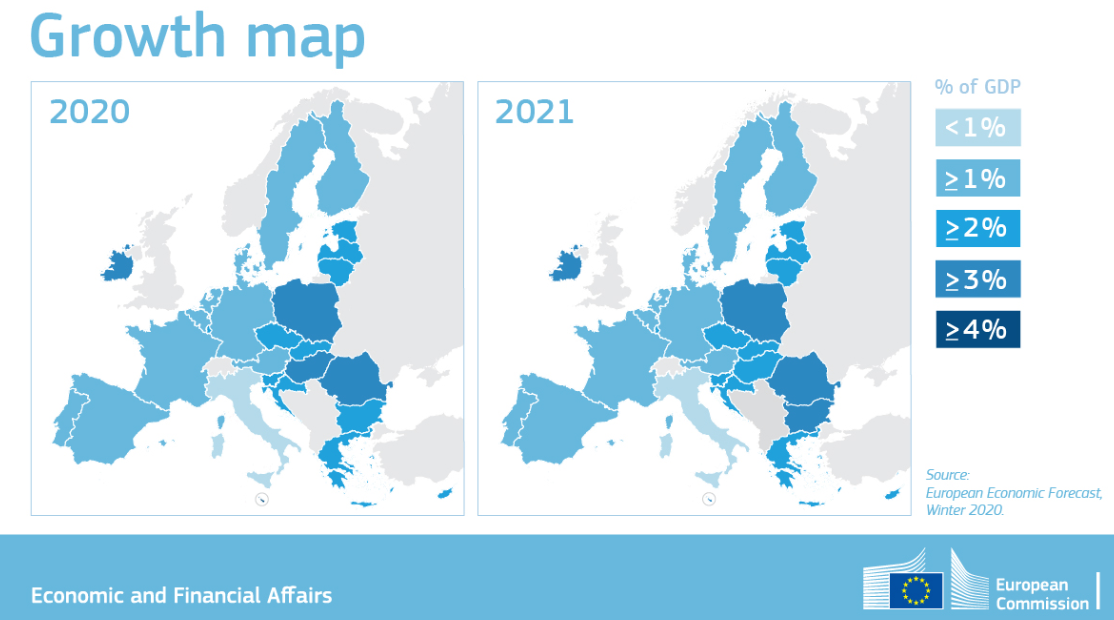
[…]Finally, fourth message, the outlook for the EU economy is subject to new downside risks, first and foremost the outbreak and spread of the coronavirus. Its impact on public health, human lives and economic activity remains uncertain. This will depend very much on the duration of the outbreak and of the containment measures enacted, and on policy measures taken by China.
The balance of risks to this forecast remains tilted to the downside. The euro area economy still faces a high degree of uncertainty, particularly regarding trade policies and the external environment.
Firstly, the outbreak and spread of the coronavirus and its economic impact is a key downside risk.
The fact that the duration and severity of the outbreak are unknown at this stage generates uncertainty over the near-term economic prospects in China and abroad.
This uncertainty comes with broad-based global ramifications for manufacturing, with its cross-border supply chains.
But it also has implications for services, including transport and tourism, both in and out of China.
What is clear is that the longer the outbreak lasts, the higher the likelihood of knock-on effects on economic sentiment and global financing conditions.
Secondly, both economic and trade-policy uncertainty remain high despite the recent US-China trade deal. Trade tensions could re-escalate and new trade barriers could be enacted. This could lead to a reversal of risk sentiment and tighter financing conditions.
China-Europe freight train restores regular operation - Xinhua, 17 Feb
Nanchang, east China's Jiangxi Province, Feb. 17, 2020. The China-Europe freight train bound for Moscow of Russia and Minsk of Belarus left Nanchang on Monday, signifying the restoration of its regular operation. The freight train carried 41 carriages of containers, fully loaded with auto parts, mechanical facilities and garments.
EU’s Digital Package in China Context
On February 20th the European Commission released the long-anticipated Digital Package, which consists of three documents: white paper on artificial intelligence, outline for single European market for data, and a 5-year policy roadmap entitled “Shaping Europe’s digital future”.
This package will help to set standards of the European way in digital development. But as pointed out by Guntram Wolff - the director of Brussels-based economic think tank Bruegel - shaping the global AI and data usage rules will not be enough for the EU to compete globally on digital development, as Europe “may be the world’s AI referee, but referees don’t win”. The US and China continue to dominate the innovation scene, as about 45% of AI-related patents are filled by the former and 40% by the latter of the two players.
Part of the problem is insufficient funding. According to DigitalEurope - a tech lobby - around 10% of the EU budget should be devoted to tech development, but the current proposal of the Commission sets the number at 3%. So the funding issue is likely to continue to be a challenge for the EU’s fragmented innovation scene.
From the perspective of Chinese digital companies, the EU’s vision of “digital solutions that put people first”, will make operating on European market more challenging, similarly like the adjustment to GDPR has. And it is good to keep in mind that Margrethe Vestager, the EU Commission’s executive vice-president on digital policy and the EU’s leading voice on digital policies, also personally has some views on China’s approach to technology. Recently she referred to this in the context of shaping EU’s rules by stating “I find it truly really scary what I saw in Hong Kong,” referring to usage of technology in anti-Beijing protests.
‘Really scary what I saw in Hong Kong’: EU to urge caution on use of facial recognition amid fears of Big Brother-style society - Agence France-Presse, 17 Feb
“I find it truly really scary what I saw in Hong Kong,” said the EU Commission’s executive vice-president on digital policy, Margrethe Vestager, who will spearhead the policy.
During a wave of anti-Beijing protests, she said, “People could get a message on the phone: ‘We know you’re there, maybe you should go home’. Not really supportive of the freedom to assemble, or to express yourself.” […]
“What we will say in the paper in a very lawyered up language is, let’s pause and figure out if there are any … circumstances where facial recognition remotely should be authorised,” she told reporters.
“Because if we do not pause, then it will … just be everywhere,” she warned comparing it to the sudden rise of CCTV security in city centres.
Europe may be the world’s AI referee, but referees don’t win - POLITICO (Guntram Wolff - director of Bruegel), 17 Feb
When European companies want to adopt AI solutions, they are almost inevitably forced to turn to vendors from the United States or China — the world’s two incontestable leaders when it comes to the technology.
The two countries dominate when it comes to innovation, with about 45 percent of AI-related patent filings made in the U.S., and another 40 perent in China. They also lead on the public research front: Two-thirds of top-filing universities and public research organizations are based in China. And they’re the major players on the commercial front: Four U.S. firms capture about a quarter of the worldwide AI market.
The EU offering is comparatively poor. Of the top 30 AI-related patent applicants, only four are European. Nor is the future looking more promising. Of the 100 most promising AI startups in the world, only two are from the EU (while six are from the U.K.), and they attract well-below-average funding. […]
concern is that giving access to data can provide long-term advantages to existing AI companies — making the development of European AI ever more difficult. While not all AI applications need large amounts of data to achieve economies of scale and scope, many do.
Only a bold strategy by Vestager and her colleague, Internal Market Commissioner Thierry Breton, can secure AI in Europe.
Europe’s digital vision, explained - Politico (Laura Kayali, Melissa Heikkila, Janosh Delcker), 19 Feb
“So-called high-risk AI — this is AI that potentially interferes with people’s rights — have to be tested and certified before they reach our single market,” von der Leyen said Wednesday.[…]
The final document now calls for “specific requirements” for “remote biometric identification systems” — a broader term describing technology that analyzes information about your body such as your face or voice, and compares that with stored data to identify individuals. Such biometric systems should adhere to strict transparency requirements as well as tough criteria when it comes to the algorithms underlying them and the data they use to be trained. […]
The Commission’s proposal for the total EU budget for the next seven years is about €1.135 trillion. Only around 3 percent of that is devoted to tech, according to tech lobby DigitalEurope, which urges capitals to raise the share devoted to the digital transformation to 10 percent.
Vatican in Talks with China
On the sidelines of the Munich Security Conference, Archbishop Paul Gallagher met with his counterpart Minister Wang Yi to discuss “renewal or formalisation” of the 2018 Vatican-Beijing deal. The deal set to expire in August, has allowed Vatican to appoint bishops pre-approved by the government of the People’s Republic of China. The details of the meeting remain unknown, but the two sides are to continue dialogue.
The 2018 deal - the text of which was never made public - helped to bridge the divide between the official Catholic Church in China, which is run by state-appointed clergy and the underground Church loyal to the pope. But the deal has also been a subject of heavy criticism by some - including former Hong Kong cardinal Joseph Zen Ze-kiun - who point out at Beijing’s oppression towards catholics in China.
It is important to point out that the Vatican remains the only sovereign European country that recognises Taipei over Beijing.
Pope Francis ‘initiated talks’ on bishops deal between Chinese and Vatican foreign ministers - SCMP (Stuart Lau), 17 Feb
A historic meeting between the foreign ministers of China and the Vatican in Munich last week was initiated and approved by Pope Francis, according to two sources familiar with the arrangements.
The Pope was “eager” to use the talks to explore “renewal or formalisation” of a provisional deal reached in 2018 to allow the Vatican to appoint bishops pre approved by Beijing, one of the sources said. The agreement is said to be expiring in August.
Beijing broke off diplomatic relations with the Holy See in 1951, and the Vatican is the only European sovereign state to formally recognise Taipei instead of Beijing.[…]
The text of the agreement, signed between the Vatican and China’s foreign ministry, was never made public.
China’s Diplomatic Spats in Northern and Central and Eastern Europe
Over last few months China has found itself in new political spats with European countries - primarily in Northern and Central and Eastern Europe.
For example, it was recently uncovered that on January 10th Chinese Embassy in Prague sent a strong worded threat-letter to Czech President’s office, in order to prevent an official visit of the Czech Speaker of the Senate - Jaroslav Kubera - to Taiwan. In the letter, the Chinese Embassy suggested that carmaker Skoda, Home Credit Group, and musical instrument maker Petrof Pianos would all be would be targeted, if Mr. Kubera makes his trip. Before the trip took place, Mr. Kubera passed away unexpectedly on January 20th.
On 12th of February the Estonian Foreign Intelligence Service released an annual report “International Security and Estonia 2020”. Aside from extensively describing threats related to Russia’s activity, the report also named China as one of potential security concerns. In the report the Intelligence Service pointed at multiple issues going beyond the frequently raised technological question related to Huawei. The authors pointed at alleged market distortions created by China’s state capitalism, extensive usage of special services, and also China’s rhetoric of “shared destiny”. This led to Chinese Embassy in Estonia describing this part of the report as “characterized by ignorance, prejudice as well as the cold war mindset”.
On 19th of February Swedish region of Dalarna along with three counties severed its political and cultural cooperation with Chinese counties and regions. This is a result of a political spat that erupted over Chinese Embassy’s harsh remarks following Swedish organization for writers and poets decision to award Tucholsky-award to the Swedish writer and a critic of China’s government Mr. Gui Minhai.
Other diplomatic incidents took place in Denmark and in Lithuania.
It is important to notice that most of those cases are related to Central and Eastern European countries, members of 17+1 framework, which is infamous in Brussels. This questions the assumptions about the influence that China has in the region. Overall, intensification of such diplomatic rows does not bode well for 2020 as China’s “Europe year”.
International Security and Estonia 2020 - Estonian Foreign Intelligence Service, 12 Feb
Orchestrated from Beijing, lobbying efforts are ongoing across the globe to feel out the situation and identify the countries most susceptible to China’s agenda. China is increasingly aware that the doors are closed in the United States, but Europe offers much more fertile soil for Chinese rhetoric. Following the NATO summit in London, a Chinese foreign ministry spokesman said China had noticed many voices inside NATO saying they did not want to view China as a threat. Lobbyists working for China are actively circling Europe and preaching the shared views of China and Europe, this way purposefully undermining Western unity.
Particular importance is attached to people’s personal relationships, which are used in an effort to bring the Chinese agenda to the decision-makers. However, it is important to understand that, in the eyes of the CPC, decision-makers in other countries are only useful pawns to help implement CPC strategies. China employs the same strategy domestically, and since Xi Jinping came to power in 2012, more than 100,000 such pawns, once useful to the party, have been removed from power in China.
Statement of the Spokesperson of Chinese Embassy in Estonia - Embassy of the People’s Republic of China in the Republic of Estonia, 14 Feb
The part concerned China is characterized by ignorance, prejudice as well as the cold war mindset. Regardless the prospective on-going relations between China and Estonia, it presents China as a so-called country of threat by stories out of nothing, distorted facts or malicious attacks. This is neither professional nor responsible. It is definitely misleading the public in Estonia and international community. It is a damage to the bilateral relations as well as the hurt of good feelings of Chinese people towards Estonia. We strongly oppose the part concerned China.
The Estonian Foreign Intelligence Service is requested, based on facts and truth, to correct its wrong expressions to remove the negative impact.
China threatened to harm Czech companies over Taiwan visit: letter - Reuters (Raphael Satter, Nick Carrey), 19 Feb
The Chinese government threatened to retaliate against leading Czech companies if a senior Czech official made good on a planned visit to Taiwan, according to a diplomatic message reviewed by Reuters. […]
The Jan. 10 letter, sent by China’s embassy in Prague to the Czech president’s office, suggested that automaker Skoda[VOWGK.UL], lender Home Credit Group, and musical instrument maker Petrof Pianos would suffer if late Czech lawmaker Jaroslav Kubera visited the self-ruled island as planned.
Kubera died unexpectedly on Jan. 20, before his trip had been due to take place, but the letter, written in Czech, reveals how explicit Beijing was about the possible consequences if the visit had gone ahead. […]
As speaker of the Czech Republic’s Senate, Kubera was the country’s second-most senior official after President Milos Zeman.
Swedish regions and counties discontinue several partnerships with China - ScandAsia (Sofia Flittner), 20 Feb
The Swedish region of Dalarna along with the counties of Linköping, Västerås, Åmåls and Borlänge has discontinued their cultural- and political partnerships with Chinese counties and regions as of 19 February 2020.[…]
“We have ended all political ties with China. This is due to the threats the Chinese embassy in Sweden has directed towards the Swedish government,” says the Council Chairman in Linköping Lars Vikinge to the Swedish newspaper.
The harsh words from the Chinese embassy in Sweden began when the Swedish division of PEN, an organization for writers and poets, awarded the Tucholsky-award to the Swedish writer- and known critic of the Chinese regime, Gui Minhai in the fall of 2019.
Alstom Preparing a Merger to Rival Chinese Train Giants
Alstom, a French trainmaker, announced on 17th of February that it signed a major acquisition agreement with Canadian company Bombardier, acquiring Bombardier’s rail business. If not opposed by competition authorities, this around €6 billion agreement would make Alstom capable of rivaling Chinese giant China Railway Rolling Stock Corporation.
Two train giants just teamed up to take on China - CNN Business (Hanna Ziady) 17 Feb
On Monday, the French trainmaker [Alstom] said it has signed an agreement to acquire Bombardier's rail business for between €5.8 billion ($6.3 billion) and €6.2 billion ($6.7 billion). […]
Alstom and Bombardier, which is seeking to reduce its debt burden as it nears the end of a five-year turnaround, had earlier confirmed the talks following a report from the Wall Street Journal. […]
The deal will be Alstom's second attempt to create a European rail company that can compete with the likes of China Railway Rolling Stock Corporation (CRRC), the world's largest supplier of rail equipment. […]
CRRC is a key rival. The state-owned rail company reported revenue of nearly €21 billion ($23 billion) in 2018, compared to a combined €15.3 billion ($16.6 billion) recorded by Alstom and Bombardier's rail unit, according to SCI Verkehr. […]
Leenen warned the proposed deal between Alstom and Bombardier could also run into trouble with competition authorities, given that together the companies deliver almost 50% of Europe's regional electric passenger trains.