EU-China News Brief - 12 February 2020
Want it brief? Listen to the podcast or read main paragraphs
Want it detailed? Read excerpts and follow links
In today’s news we cover:
Coronavirus Update
Coronavirus & Europe - Reaction and Impact
Europe Responds to Huawei
MERICS - Survey on EU-China Relations in 2020
Europe Plans to Build Industrial Champions
Balkans, EU, China - Strategic Membership Criteria
Coronavirus Update
Updated numbers and status
The virus was officially named by WHO as coronavirus “SARS-CoV-2” causing disease “COVID-19.”
As of 12th of February 2020, the number of confirmed cases in Mainland China reached 44,653 with 1,113 deaths. In Europe the number of confirmed cases reached 41 with no deaths confirmed. Here is the distribution: Germany - 14, France -11, UK -8, Italy - 3, Spain -2, Belgium - 1, Finland - 1, Sweden - 1 according to the situation report by WHO.
On January 30th, the WHO decided to declare coronavirus a “public-health emergency of international concern” . As such the case of coronavirus became the sixth disease outbreak to get such a status. The Director of WHO - Dr Tedros Adhanom Ghebreyesus - stressed his belief in China’s ability to solve the situation and called the travel and trade bans imposed on China excessive.
WHO Director-General's statement on IHR Emergency Committee on Novel Coronavirus (2019-nCoV) - WHO, 30 Jan
"The main reason for this declaration is not because of what is happening in China, but because of what is happening in other countries. Our greatest concern is the potential for the virus to spread to countries with weaker health systems, and which are ill-prepared to deal with it."
“There is no reason for measures that unnecessarily interfere with international travel and trade. WHO doesn’t recommend limiting trade and movement. We call on all countries to implement decisions that are evidence-based and consistent. WHO stands ready to provide advice to any country that is considering which measures to take.”
However, on 11 Feb the Director of WHO warned again not to underestimate the virus, which remains “a grave threat”, particularly as a vaccine may take 18 months to develop.
Experts remain divided as to wether the spread of the virus has already peaked. According to data on Chinese media, the number of new cases has been going down over the last few days. Zhong Nanshan, an 83-year-old epidemiologist who helped to fight the 2003 SARS epidemic and is currently government’s senior medical adviser estimates the outbreak of the virus may finish in April.
Exclusive: Coronavirus outbreak may be over in China by April - expert - Reuters 11 Feb
But Zhong was optimistic the new outbreak would soon slow, with the number of new cases already declining in some places.
The peak should come in middle or late February, followed by a plateau and decrease, Zhong said, basing the forecast on mathematical modelling, recent events and government action.
“I hope this outbreak or this event may be over in something like April,” he said
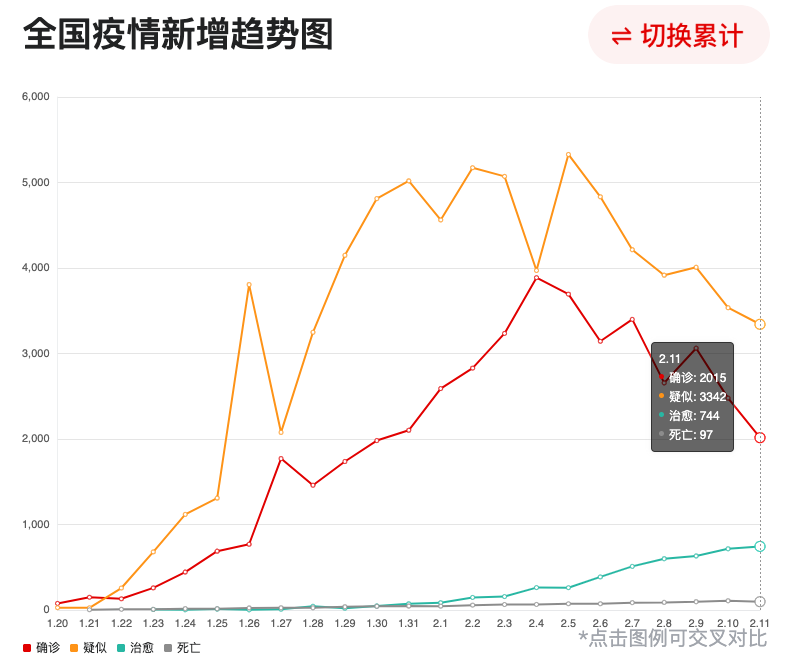
Statistics for the entire country, Data for 12 Feb published by IFeng News
Red - Confirmed cases, Yellow - suspected cases, Green - Cured, Gray - Deaths
[UPDATE - Numbers spike Feb 13]
After the authorities adjusted the diagnostic criteria to be broader, the number of confirmed cases have spiked as over 15,000 cases were linked to the coronavirus. The number of deaths also increased, but the overall death toll remains at around 2%.
The numbers went up due to better criteria for reporting rather than a dramatic change in the situation on the ground. Still, the psychological effect of this change should not be understated. The broader definition can make official Chinese data closer to the reality.
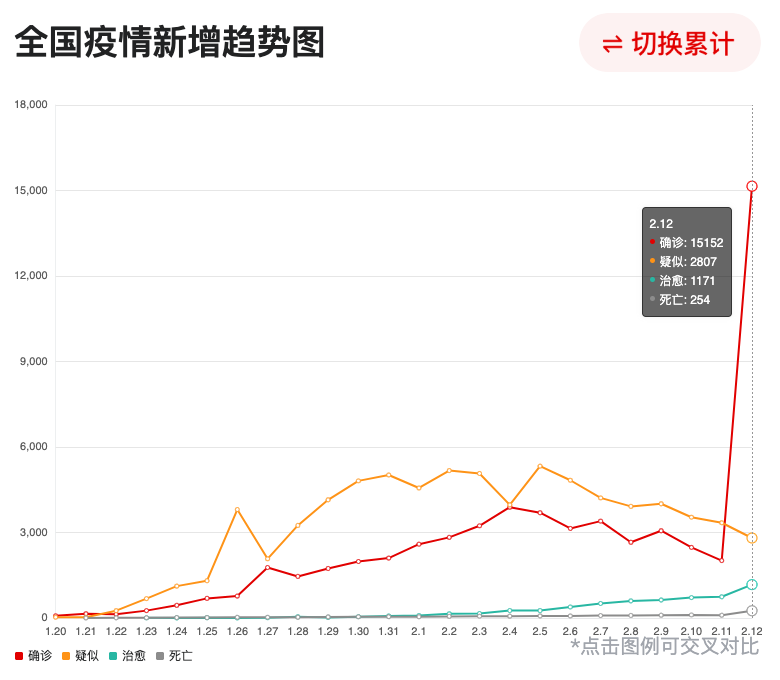
Statistics for the entire country, Data for 13 Feb published by IFeng News
Red - Confirmed cases, Yellow - suspected cases, Green - Cured, Gray - Deaths
For more check out this update from SCMP: Coronavirus: Hubei province reports spike in new confirmed cases and deaths after change in diagnostic criteria, 13 Feb
Praising & Criticism
Chinese authorities have been praised by WHO for their rapid and decisive response to the coronavirus threat. Also for the impressive speed with which two medical facilities (火神山医院 Huoshenshan hospital with 1,000 beds and 雷神山医院 Leishenshan hospital with 1,600 bed ) were constructed in Wuhan in within 2 weeks.
However, stories contradicting the official narrative began to emerge. Caijing published an article (which quickly got censored) questioning the official statistics over misclassifying death causes and uncovering how only people admitted to the hospitals figure in the death statistics. Moreover, unofficial reporting circulated the web with videos of patients being kept in confinement without medical attention.
Furthermore, discontent erupted after the death of Dr. Li Wenliang (李文亮), who is called one of the initial “whistleblowers”, although he simply shared information about the new disease during the very early days of the outbreak on a WeChat group with fellow doctors. Now hailed a hero, he was among eight doctors persecuted by the police for spreading rumors.
In general, the official line is that mistakes were made by local level officials over handling the initial phase of the virus outbreak and now the central government is coordinating an effective action. It is a narrative that is often used in China.
WHO Director-General's statement on IHR Emergency Committee on Novel Coronavirus (2019-nCoV) - 30 January
As I have said repeatedly since my return from Beijing, the Chinese government is to be congratulated for the extraordinary measures it has taken to contain the outbreak, despite the severe social and economic impact those measures are having on the Chinese people.
The speed with which China detected the outbreak, isolated the virus, sequenced the genome and shared it with WHO and the world are very impressive, and beyond words. So is China’s commitment to transparency and to supporting other countries.
In many ways, China is actually setting a new standard for outbreak response. It’s not an exaggeration.
Life inside China’s rapidly built hospitals in Wuhan, the epicentre of the coronavirus outbreak - video by SCMP, 10 Feb
统计数字之外的人:他们死于“普通肺炎”?People outside of the statistics: The died of “common phneumonia”? - Caijing, translation
Caijing understands that at least five suspected deaths at the hospital have not been diagnosed, so it does not count towards the confirmed deaths. This means that the number of confirmed and fatal cases that people can see at present does not fully reflect the full picture of the epidemic.
From the current survey, there are two main ways patients can be admitted. The first is to queue up by the community: After the implementation of the community shunting policy in Wuhan on January 24, patients need to be admitted to the hospital with a hospitalization ticket-patients first go to the community to submit CT and blood routine reports, the community reports to the street, and then according to the priority of the new hospital Bed; Second, go to the designated hospital with nucleic acid test strips, get the results 48 hours, after the diagnosis can not be rejected by the hospital.
Li Wenliang’s death is a new crisis for China’s rulers - The Economist
On the evening of February 6th Mr Li was killed by the pathogen, having been infected by a patient a few days after the police told him to shut up. His death has prompted one of the biggest outpourings of online criticism of the government in years. Officials struggling to contain the virus are also now battling to assuage public anger.
Mr Li is being hailed by Chinese netizens as a whistleblower, but all he did was post a few sentences about the virus on a private forum used by former classmates from his old medical school, most of whom are also practising doctors.
Impact on Chinese economy
The disruption to Chinese economy shown by stocks falling around 9% in Shanghai and Shenzhen pushed the government to stimulate the economy through People’s Bank of China injection of 1.7 trillion CNY as well as special subsidies and tax reliefs. Consequently, the immediate impact on Chinese economy will be cushioned, but there may be mid-term effects due to supply chain disruptions and further growth of debt on local level. The focus on a short time perspective will be considerable, given the Party has to achieve one of its century goals - building a moderately prosperous society (小康社会) by 2021 for the 100 anniversary of the foundation of Communist Party of China. This goal is understood as doubling the 2010 levels of GDP per capita.
Stocks Sink as Markets Open in China - NYT, 2 Feb
Stocks in China plunged in early Monday trading as investors returned from a long holiday to the prospect of the world’s No. 2 economy virtually shut down by the coronavirus epidemic.
Stocks in Shanghai opened 8.7 percent lower, while shares in the southern Chinese boomtown of Shenzhen fell 9 percent. The markets had been closed since Jan. 23 for the Lunar New Year holiday, and government officials extended that closure until Monday while the authorities dealt with the outbreak.
As virus fallout widens, China readies more measures to stabilize economy - sources Reuters Feb 4
The People’s Bank of China (PBOC) has already pumped in hundreds of billions of dollars into the financial system this week as it attempted to restore investor confidence and as global markets shuddered at the potentially damaging impact of the virus on world growth. In the past two days, the PBOC has injected 1.7 trillion yuan ($242.74 billion) through open market operations.
In order to minimize job losses, China’s stability-obsessed leaders are likely to sign-off on more spending, tax relief and subsidies for virus-hit sectors, alongside further monetary easing to spur bank lending and lower borrowing costs for businesses, according to the policy insiders.
China’s Coronavirus will not lead to recession but to stimulus and even more debt Alicia Garcia-Herrero, Bruegel, 4 Feb
Based on the SARS’s experience, the service sector is likely to be more severely affected than the manufacturing sector, especially for transportation, which continues to be an important part of the service economy. The second reason is that investor’s confidence has already been hardly hit by the trade war. […]
the coronavirus is hitting a weaker economy than was the case with SARS. Based on the above, and assuming that the peak of the coronavirus outbreak happens in the first quarter -which is a very optimistic assumption – we should be expecting a rapid deceleration of economic activity in the first quarter and gradual stabilization for the rest of 2020. […]
As such, we expect the quick policy reaction to avoid a sharp correction in growth so that the Party’s objective of income doubling can be achieved.. This means that 2020 growth for China may still hover around 5.7-5.5% but with dear consequences. Debt will continue to pile up, for corporates, for the government and even for households, as they are pushed to consume more durable goods with subsidies and discounts. More debt for an already highly indebted country like China can only mean lower potential growth than the road. In that regard, one could argue that the negative consequences of the coronavirus on the Chinese economy may be more medium term than immediate
Impact on Europe
EU’s Response
In response to the coronavirus outbreak, on January 28th the European Commission activated the EU Civil Protection Mechanism to coordinate the action of repatriating around 500 EU citizens from China. Moreover, the EU decided to devote €10 million euros from Horizon 2020 to research into the coronavirus.
The EU also assisted China in procurement of 12 metric tonnes of medical supplies answering the request of Premier Li Keqiang
Limitations on acquiring new Schengen visas for people who travelled in China in recent months were put in place. And many of the European airlines including - Lufthansa and its subsidiaries, Air France, or LOT Polish Airlines - were among more than 40 airlines that suspended flights to China.
Some of the EU countries decided to block flight connections with China altogether - as was decided by Italy (ban until April 28) or by Czech Republic. However, we got to know directly from people who recently travelled back to one of those countries from China, they can still be reached relatively easily using a connecting flight.
Coronavirus: EU calls for strengthened international coordination and cooperation - European Comission, 10 Feb
With the activation of the EU Civil Protection Mechanism by France in late January, 558 people, including 447 EU citizens, were already flown in from the Wuhan region on three flights that were co-financed by the EU – two organised by France and one by Germany - on 31 January and 2 February 2020. The EU's Emergency Response Coordination Centre is liaising with all EU Member States to facilitate the delivery of needed personal protective equipment to China, in addition to the 12 tonnes already mobilised by Member States on 1 February as an immediate response.
The EU also announced on 31 January 2020 that it is providing €10 million from its research and innovation programme, Horizon 2020, to support research into the new Coronavirus disease. The European Centre for Disease Control (ECDC) is closely monitoring the evolution of the outbreak.
China's Premier Li Keqiang asks EU to facilitate urgent procurement of medical supplies - Strait Times, 1 Feb
China's Premier Li Keqiang has asked the European Union (EU) to facilitate China's urgent procurement of medical supplies from member countries, the Chinese government said on Saturday (Feb 1).
China will also implement tax exemptions for imports of products related to curbing the coronavirus outbreak, the finance ministry said on Saturday.
Materials directly used for epidemic control will be exempt from import tariffs from Jan 1 to March 31, the ministry said in a statement on its website.
Impact on EU-China Relations
The coronavirus outbreak can disrupt negotiations on EU-China Comprehensive Agreement on Investment as the next round of negotiations was scheduled to take place between 4th and 6th of March in Beijing. That - together with the fact that key negotiating issues remain unresolved - puts completing negotiations on CAI in 2020 into question. We have also seen examples of China-related events and meetings being cancelled in Brussels - in many cases over illogical fears related to the coronavirus.
We also heard that the EU-China Summit which is to take place on 30th-31st of March may be affected by the outbreak of the coronavirus, but it still remains to be seen. What is more, the non-essential operations of the EEAS in China have been suspended.
Coronavirus threatens EU-China agreement in 2020 - Euractiv, 4 Feb
Concluding an EU-China investment deal this year could be a “real challenge” and the coronavirus outbreak will make it even more difficult as it will force both sides to cancel negotiation rounds, the EU Chamber of Commerce in China has warned.
EU and China agreed last year to conclude the investment deal in 2020. But the slow progress made since 2012 over 25 rounds risks being further hampered by the spread of the coronavirus.
[…]The two sides met in Brussels on 16-17 and 20-21 January and the next face-to-face is scheduled for 4 and 6 March. In the last round, they discussed the revised offers exchanged in December and made comments for further improvements
The coronavirus epidemic could upset a crucial year for China-EU relations - Quartz, Feb 6
The European Commission and the EEAS “have suspended all non-essential missions to China” until Feb. 16, the spokesperson said, and “recommended that all non-essential visits and meetings coming from China are to be temporarily postponed.”
Impact on EU economy
The European businesses that are affected most profoundly at this stage are from tourism, luxury, and automotive industries.
The travel restrictions on Chinese tourists will impact especially popular destinations. Italy may lose up to €4.5 billion EUR or 5% of its tourism income. In France Chinese tourists make up 7% of tourists coming to the country, but account for a third of sales of luxury items. On the automotive market, the German carmakers are expected to be hit particularly hard by the falling sales in China and disruption of production and supply chains.
France-Chinese tourism business in free fall as coronavirus outbreak spreads - Radio France Internationale 29 Jan
With sales figures down by at least 33% for the 50 agencies who bring up to 150,000 Chinese tourists to France and Europe within ACAV, the agency is now looking to name a certain number of personnel as "temporarily unemployed" as the travel arrangements for the first quarter of 2020 have been cancelled.
With 2 million visitors to France per year, China represents a significant share of the tourism market and are seen as the biggest spenders. Chinese tourists make up 7% of the overall dividend for France's tourism sector - to the tune of €4billion - but only represent 2 .5% of all visitors coming to France. [..]
Today, Chinese visitors account for 33% of sales in the luxury goods sector compared to only 10% back in 2003 when the SARS respiratory epidemic was at its peak
UK, France Urge Citizens Out of China; Belgium Sees 1st Case - New York Times, Feb 4
Italy could lose up to 4.5 billion euros ($4.97 billion) in tourism revenue this year if coronavirus fears keep visitors away, leading polling agency Demoskopika said in a study released Tuesday. The amount represents around 5% of tourism-generated contribution to Italy’s gross domestic product.
Coronavirus could hurt German economy due to its reliance on China - Euractiv, Feb 7
Germany’s automotive industry, in particular, will be affected. About one-third of all German vehicles (about 5.2 million units) were sold in China in 2019, calculated Centre for Automotive Research, known as CAR.
Besides, many German carmakers have their production facilities in China. In 2019, around 30 factories operated German car manufacturers, writes the German Association of the Automotive Industry (VDA).
In addition, German suppliers of automotive parts have 315 locations in China and that supply chain is also coming under threat. Even across industries, German companies are dependent on Chinese supplies, as industrial goods from China account for 9.4% of the imports of intermediate goods.
Fiat warns of coronavirus risk to Europe car plant - BBC, Feb 6
Fiat Chrysler says the impact of the coronavirus epidemic could halt production at one of its European car plants within four weeks. […]
Fiat said supply chain issues could stop factory production in two-to-four weeks but he did not name the facility. […]
Nissan, General Motors, Honda, Renault and Peugeot-owner PSA are among the companies with major facilities in Hubei province and Wuhan city, which has been in lockdown since January.
Fiat's chief executive, Mike Manley, told the Financial Times there was one "critical" supplier of parts that was putting European production at risk. He said he was also concerned about the possible impact of three other suppliers in China.
‘Too early to assess’ the impact of coronavirus, Commission says - Euractiv, 12 Feb
The European Commission will not factor in the coronavirus in its updated growth forecast on Thursday (13 February), as it considers that it is too early to estimate the impact of the virus on the region’s output, EU sources told EURACTIV. […]
Rating agency S&P said on Wednesday that the eurozone economy could grow between 0.1-0.2% less this year due to the impact of the coronavirus on the exports to China and corporate investments.
The rating agency expects that the impact will be mostly concentrated in the first quarter, although some other sectors including tourism could take more time to recover.
The Commission’s updated forecast will be discussed by the eurozone finance ministers next Monday (17 February).
Troubling Sinophobia
The fears related to the outbreak of the coronavirus led to a disturbing rise in sinophobic incidents in Europe, as many very wrongly connect the virus with ethnic background. In opposition to these tendencies, in France and in Italy social media campaign “I am not a virus” were launched to counter the sinophobic sentiments.
Coronavirus: France faces 'epidemic' of anti-Asian racism - Euronews, Feb 3
A new hashtag has gained popularity in France in recent days as the Coronavirus spread from China to dozens of other countries.
#JeNeSuisPasUnVirus or "I'm not a virus" reflects the increasing frustration of French-Asian citizens, who are facing a new wave of stigma and discrimination in the wake of the epidemic.
This phenomenon is affecting not only citizens of Chinese descent but Asians as a whole. And it's not just happening online but also on public transport and in schools.
"Yes, People are insulted and kicked off public transport because they are Asian. It's not just jokes/hatred on social networks. Discrimination also happens in real life," tweeted French journalist Linh-Lan Dao.
"Expressions such as 'yellow alert' or 'Chinese virus' send a message that all Asian people are necessarily carriers of the virus. But an Asian citizen living in France who has never been to Asia or China, at least not in the past three months, she is no more likely to be infected than a person of another origin."
Coronavirus: Chinese targeted as Italians panic - BBC, 4 Feb
A music school in Rome told East Asian students not to attend classes due to incidents of racism.
Four governors of northern Italian regions called for children returning from trips to China not to attend school for 14 days.
Prime Minister Giuseppe Conte reprimanded the regional governors, telling them that they were not competent to make such a call and that nothing justified such fear.
Yet his government's declaration of a six-month state of emergency, following two cases of coronavirus in Italy, is the first such decision due to health reasons in the country's history - and has increased alarm.
Some 300,000 Chinese nationals live in Italy and five million Chinese tourists visit every year, pouring much-needed money into the stagnant Italian economy.
Europe’s Response to Huawei
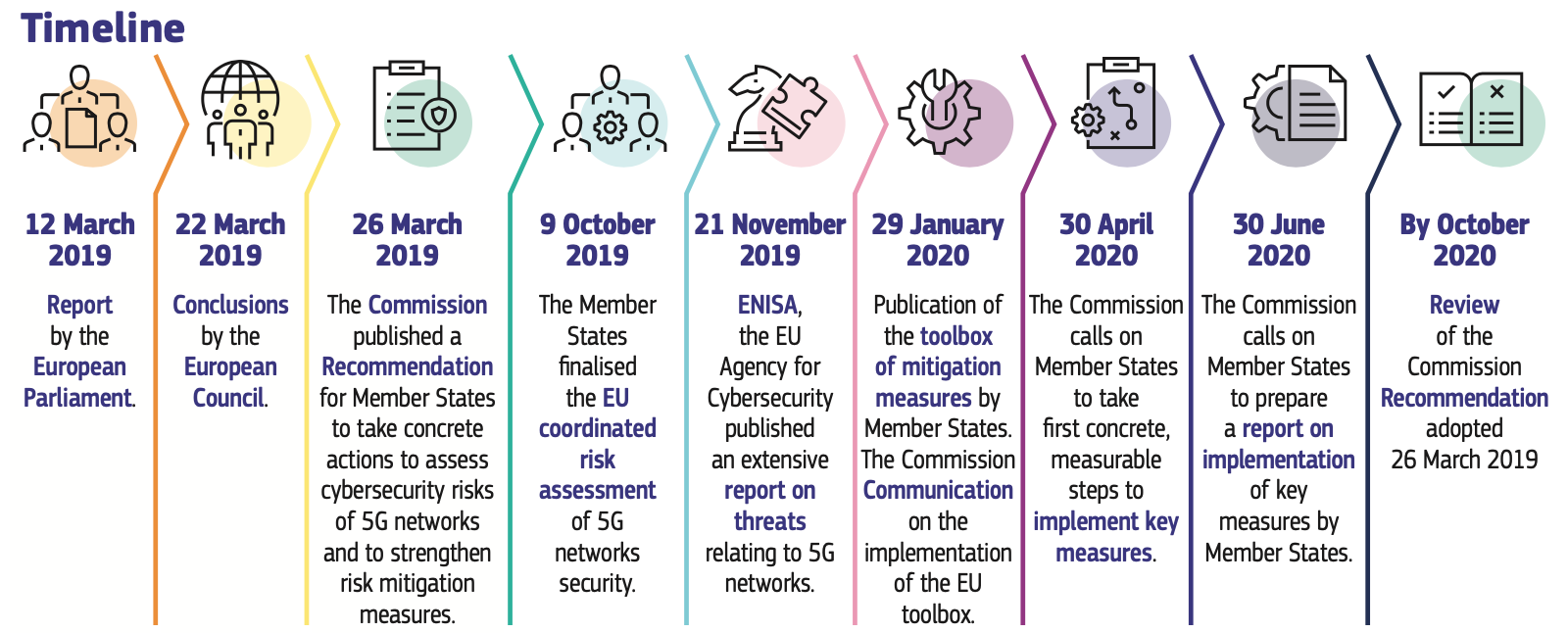
On 29th of January the EU released its long awaited Toolbox on 5G Cybersecurity. The content was based on 5G security recommendations put together by member states and the European Union Agency for Cybersecurity (ENISA) from October last year. Huawei (or ZTE - another Chinese provider) was not mentioned by name in the toolbox, but it is clear that it is the high-risk supplier that is connected to “risk of interference by a third country or dependency risks”.
The goal of the Toolbox is to mitigate the cybersecurity risks related to roll out of 5G. It is to be achieved by providing member states with a framework for increasing national telecommunication cybersecurity standards and for increasing coordination among the member states and relevant actors on the cybersecurity issue. Most of EU countries still apply telecommunication regulations introduced in 2011, which have to be updated given the evolution of the technology and more coherent on the European level .
Suggested measures include diversification of equipment suppliers, limiting high-risk providers’ access to sensitive parts of networks as well as increasing security requirements for mobile network operators. Importantly, the Toolbox also highlighted the Commission’s role in investigating potential dumping cases in the sector, which may be aimed at Chinese companies. What is more, the Toolbox also mentioned the EU’s plans to develop its industrial policy tools with a goal of enhancing technological sovereignty of the block. Another important point is developing EU-wide ICT certification scheme prepared by ENISA under the EU Cybersecurity Act from 2019, which also were mentioned in the Toolbox - we talked about it a bit more in-depth in our news brief from January 13th.
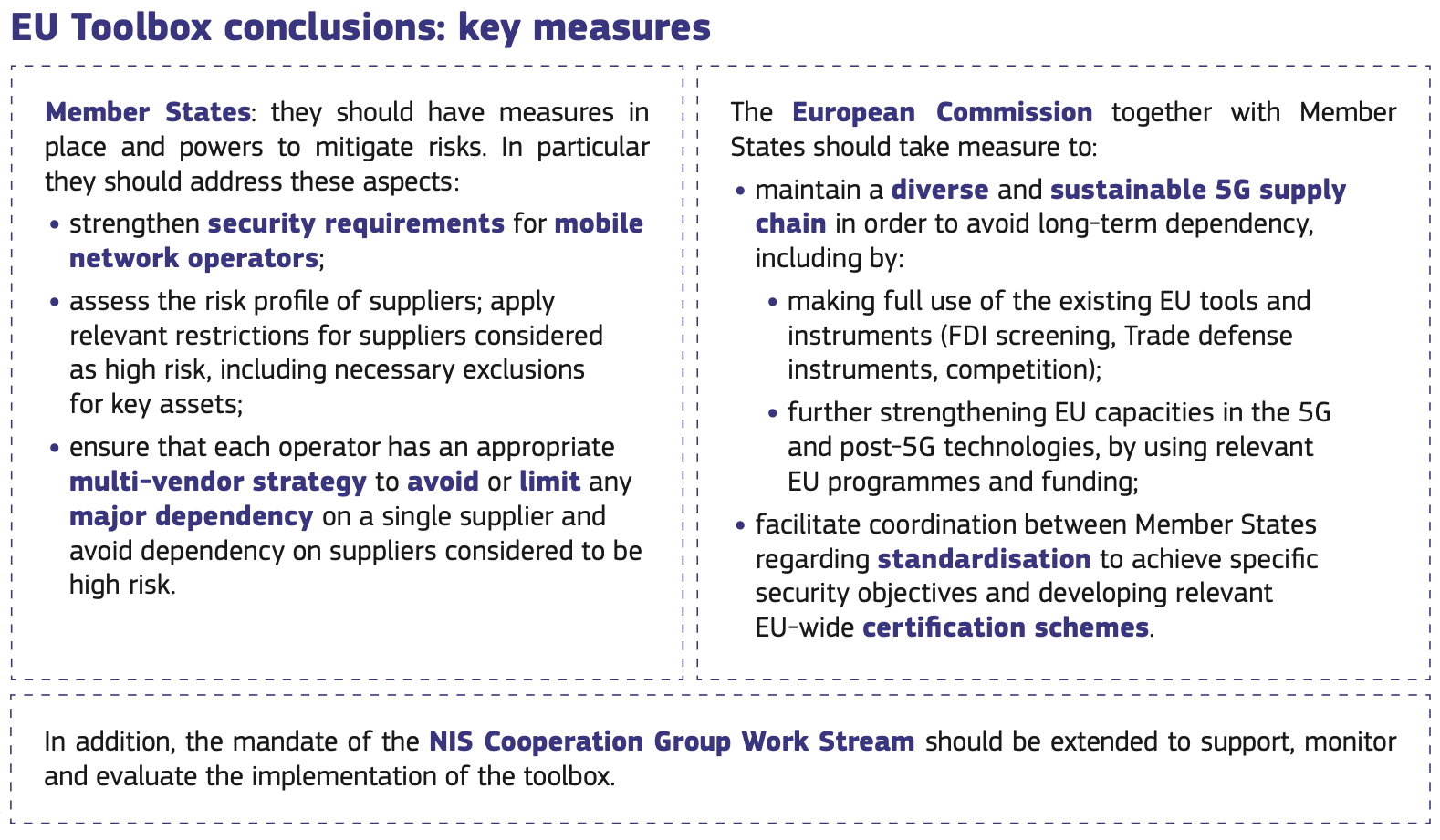
More at: Cybersecurity Toolbox Factsheet
The Commission expects member states to implement first measurable steps outlined in the toolbox by 30th of April 2020 and report to the Commission on their progress by the end of June.
Naturally, the final decision on how to tackle Huawei issue remains with the member states, but the toolbox provides a framework for a coordinated approach and -over time - converging European telecommunication security policies. It is, however, likely - as we argued back in 2019 - that the EU member states at large will take an evidence-based, middle-ground approach of not banning Huawei at the same developing risk mitigating mechanisms. The political (choosing a side in US-China rivalry) and economic (both logistic and repercussion of spat with China) costs are simply too high for the European governments.
More at: Cybersecurity Toolbox Factsheet
The decisions of member states on Huawei will have an important impact on negotiations of EU-China Comprehensive Agreement on Investments, as China clearly mentioned access to European market for its technology companies as a key issue.
Interestingly, in a move to boost Huawei’s credibility in Europe on 4th of February Abraham Liu - Huawei's chief representative to the European Union Institutions - announced that the company is planning to build manufacturing hubs in Europe to "truly have 5G for Europe made in Europe." We are yet to hear exact details regarding those plans. But bear in mind that Huawei already has 12 research centers on the European continent.
An example of answering the Huawei question on a national level is the UK, as a day before the EU toolbox got announced UK Prime Minister Boris Johnson made his decision on the issue. The UK will allow Huawei to participate in construction of its networks with exception of “critical national infrastructure” and military-related networks. Aside from that the British government also introduced a requirement of keeping the percentage involvement of Huawei’s or other high-risk vendors’ equipment down to 35% in the network. Over the past six months, the big four of the UK telecommunication scene – EE, Vodafone, O2, Three – has already started 5G trials with Huawei equipment, but may need to downscale usage of the equipment to meet the new standards. Some mobile operators that don’t rely on Huawei too much may decide to fully remove its equipment, as shown in the case of Vodafone in the UK.
Cybersecurity of 5G networks - EU Toolbox of risk mitigating measures - EU Commission, 29 Jan
On 5G, Brussels is up to the job - Janka Oertel, ECFR, 3 Feb
The diversity of the supply should be guaranteed by targeting subsidised vendors directly with anti-dumping/anti-subsidy measures. The latter especially is a measure that lies squarely within the competencies of the commission. The paragraph spelled out in the toolbox document is almost a mild threat: “The European Commission is responsible for investigating allegations of dumping by exporting producers from non-EU countries, or in the case of trade-distorting subsidies. It usually opens an investigation after receiving a complaint from the EU producers concerned, but it could also exceptionally do so on its own initiative”
The EU appears set to use the tools it has available to enhance European technological sovereignty. This includes EU Research & Innovation Funding programmes as well as industrial policy tools and the foreign direct investment screening mechanism, which was one of the key achievements of 2018-19, designed in light of Beijing’s market-distorting practices and demonstrating the possibilities of united European action.
Vodafone to remove Huawei from core of European network - Reuters, 5 Feb
“We have now decided, as a result of the EU toolbox and the UK government’s decision, to take out Huawei from the core,” Nick Read, CEO told reporters on Wednesday.
“This will take around five years to implement at a cost of approximately 200 million euros (US$220.4 million).”
Read said Vodafone would only have to make minor adjustments to comply with the rules in Britain, where it has not deployed Huawei in its core.
Vodafone does use Huawei in its core in Spain and in some smaller European markets.
Huawei to set up manufacturing bases in Europe - Xinhua, 5 Feb
Chinese technology firm Huawei said here on Tuesday that it has decided to set up 5G manufacturing bases in Europe, so that to "truly have 5G for Europe made in Europe."
Abraham Liu, Huawei's chief representative to the European Union Institutions, said in the company's spring reception that the company has already had candidate places in mind, and "that is an ongoing process."
When asked by a Xinhua reporter whether this decision would improve Europe's confidence in the security of Huawei's products, former European Commission Vice-President Viviane Reding replied "yes, of course", since the manufacturing would be "under European rules, and so that will really be a boost to credibility."
MERICS - Survey on EU-China Relations in 2020
On January 28th MERICS - leading China think tank based in Berlin - released the results of its China Forcast 2020 survey which analysed opinions of around 150 China experts and practitioners (with the sample dominated by representatives of Western Europe - 62%).
According to the results, European experts expect deterioration of political relations and stability of economic relations (without much optimism for improvement). The respondents are cautiously optimistic about building European unity through Leipzig summit and would like to see the European Commission to lead on forming the united European policy on China.
See all the findings: MERICS China Forecast 2020
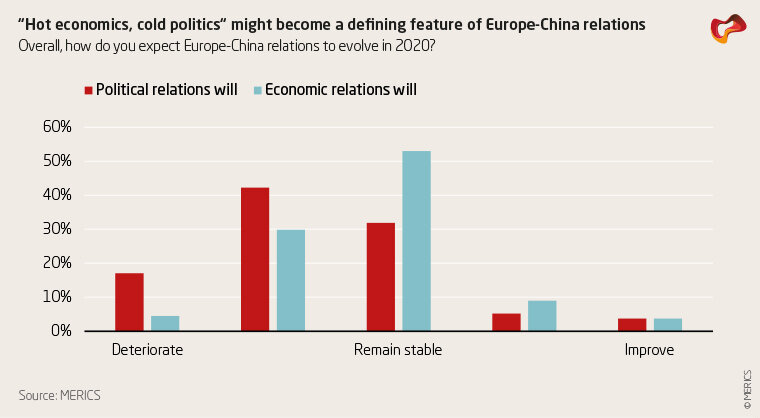
According to the MERICS survey, 59 percent of respondents expect political relations between Europe and China to worsen in 2020 (17% say they will deteriorate, 42% say they will slightly deteriorate). Respondents believe the number one factor behind growing tensions will be politically motivated retaliation by Beijing against European governments or companies. This ranked above other factors, such as restricted access to the Chinese market or human rights violations. Surprisingly, only 4% of the respondents expect Europe-Chinese relations to improve in 2020. On the economic front however, 53 percent of the experts surveyed said relations would remain stable while 13 percent predicted improvement. MERICS China Forecast 2020
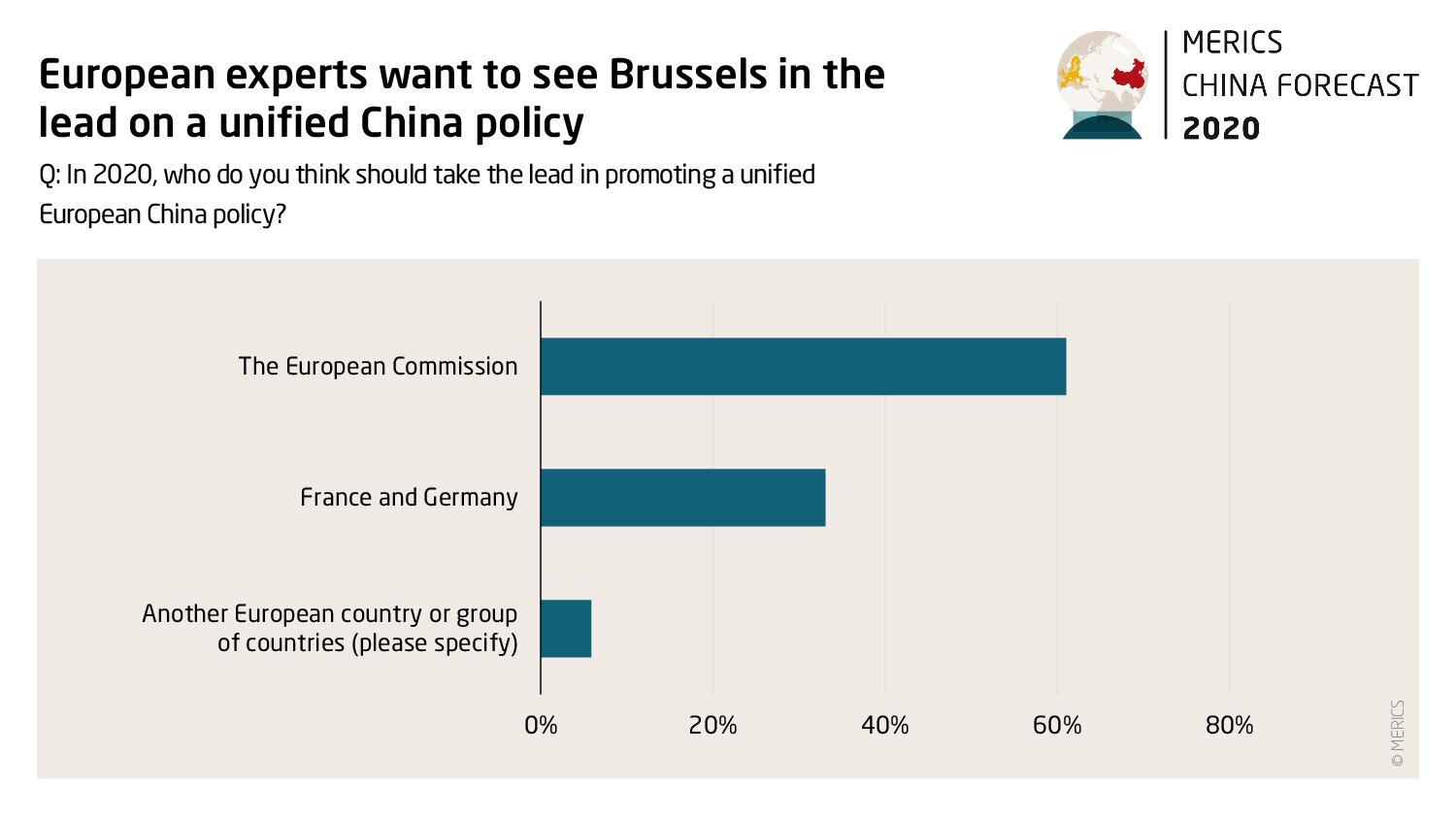
You may also watch the event launching the MERICS China Forecast 2020.
Europe Plans to Build Industrial Champions
In an unusual step governments of France, Germany, Italy, and Poland sent a letter to Commissioner for Competition Margrethe Vestager urging her to quicken her work on revision of EU competition law, which she announced in December 2019. That came after Vestager’s decision blocked merger between Alstom and Siemens, which could create a powerful, global European player in the train sector - capable of competing with Chinese companies.
China plays an important part in the move by the four capitals, as they call for “competition toolbox” that would target market distortions caused by Chinese SOEs. This plays into a wider debate on Europe adjusting its industrial policies and competition regulations to become more competitive globally and address the challenge posed by Chinese companies on the domestic market.
On a similar note, Germany and France are jointly working to establish an electric-car battery factory capable of taking on China-based Tesla. The project is to cost €5 billion.
EU big four press Vestager to clear path for champions - POLITICO, 6 Feb
China looms large in the ministers' wish list. France and Germany argue that Brussels was wrong to block Alstom-Siemens because the antitrust enforcers failed to take a sufficiently global view of competition that would have shown the rising threat posed by state-backed Chinese industries. For this reason, one of the key demands from member countries is a new "market definition" that would put greater focus on China.
In another measure apparently aimed squarely at China, the ministers asked for a "competition toolbox more efficient and effective in tackling potentially abusive behavior in the single market of economic actors from outside the EU, including state-backed or subsidized companies."
One of the proposals favored by more defensive EU industries is the suggestion that the onus would fall on Chinese investors to prove that they are not backed by state subsidies when operating in Europe, rather than the burden being on the EU side to prove that they are state-backed.
Europe pushes plan to build a gigafactory to rival Tesla, China on electric-car batteries - LA Times, 7 Feb
Germany and France set out a blueprint for a giant battery factory, advancing Europe’s 5 billion euro ($5.5 billion) bid to rival the capacity of Tesla Inc. China to supply the key part for electric vehicles.
The announcement at Germany’s Economy and Energy Ministry units underscores determination by European Union nations to catch up with Asian competitors that dominate battery making.
The Kaiserslautern factory will be up and running by 2024 and employ 2000 people, Opel’s management board head Michael Lohscheller said.
Balkans, EU, China - Strategic Membership Criteria
A new basis for EU enlargement procedures for Western Balkans was proposed on February 5th in a joint communication issued by the European Commission. The new procedures are being developed following France’s veto of initiation of talks with North Macedonia and Albania includes.
Importantly, the new proposal includes the need to pursue “strategic communication” with the EU and be able to “tackle malign third-country influence”. This vague concepts are interpreted by some as EU’s attempt to curb China’s influence in the Balkans. This would be in line with the overall trend for greater assertiveness that has been emerging since last EU-China Summit in 2019.
Enhancing the accession process – A credible EU perspective for the Western Balkans - European Commission Communication, 5 Feb
Proposed EU criteria for new members show wary Europe has China on its mind - SCMP, Emilian Kavalski, 11 Feb
While the overhaul of the political, economic and human rights criteria for accession is not surprising, the proposal also outlines strategic convergence with the EU as a key criterion for membership.
Notably, the proposal states that candidate countries will also be evaluated annually on their ability to “tackle malign third-country influence”. This phrase, which is not spelt out anywhere else in the document, is highly open to interpretation.
It is likely that the criterion of strategic compliance with the EU would become one of the most contested grounds in the annual review of candidate countries, and not only because of the fuzzy definition of the concept. Interpretations of “malign influence” are likely to differ among the member states, as evidenced by the European divergence on Huawei’s involvement in the construction of European 5G networks. Thus, Chinese investment might become a make-or-break condition of EU accession for the Western Balkan states.